
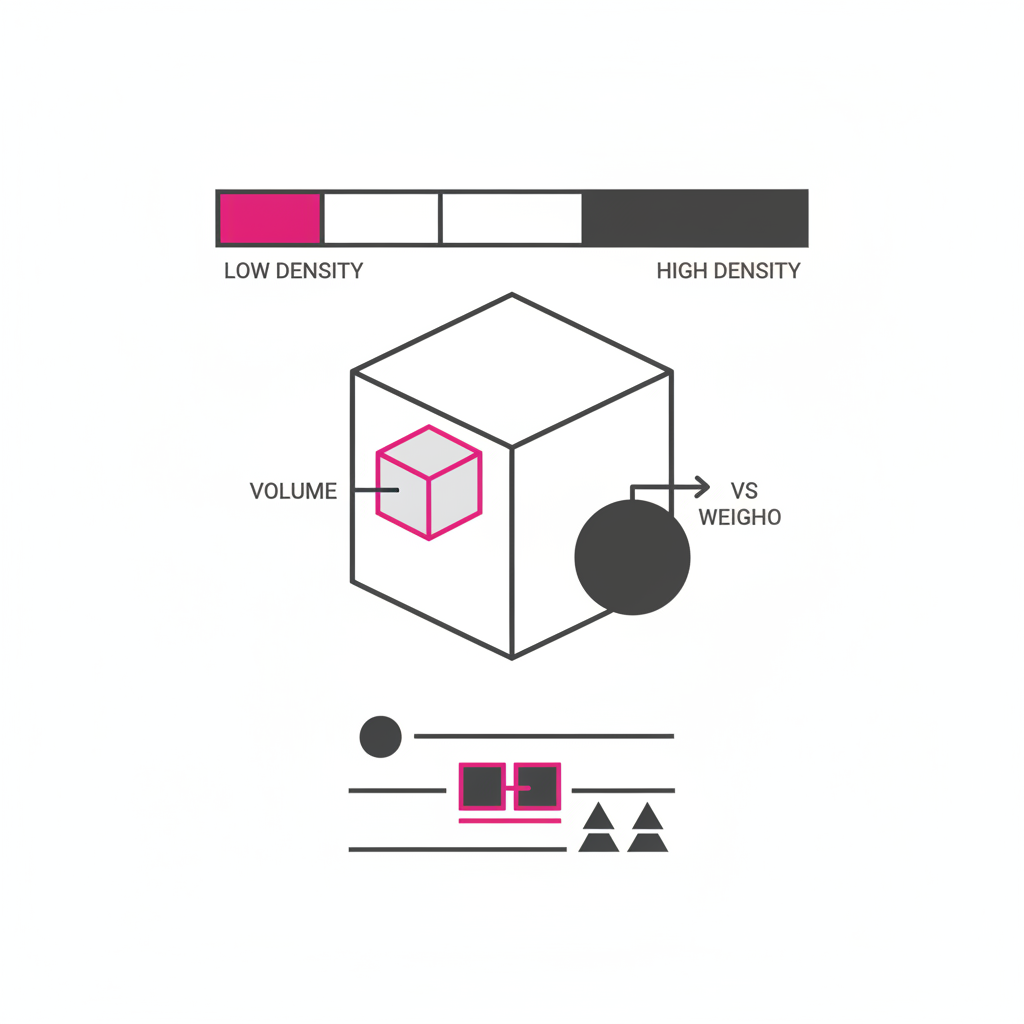
Density-based freight classification is a pricing methodology used in less-than-truckload (LTL) shipping where the freight class — and therefore the rate — is determined by the density of the shipment rather than its commodity type. Density is a single, objective measurement: weight divided by volume.
The National Motor Freight Classification (NMFC) has progressively expanded density-based classification to cover most commodity categories, moving away from the older system of commodity-specific item numbers that required a deep knowledge of NMFC tariffs. Under density-based rules, you do not need to know the NMFC item number for a commodity. You need to know its weight and dimensions.
Freight density is calculated using this formula:
Density (lbs/cubic foot) = Actual Weight (lbs) / Volume (cubic feet)
Volume is calculated from package or pallet dimensions:
Volume (cubic feet) = (L inches x W inches x H inches) / 1,728
The resulting density in pounds per cubic foot is then matched to the NMFC density table to determine freight class.
Example calculation:
A pallet weighing 300 lbs, measuring 48 x 40 x 48 inches.
Volume = (48 x 40 x 48) / 1,728 = 53.33 cubic feet
Density = 300 / 53.33 = 5.63 lbs/cubic foot
Freight class = Class 150 (the NMFC density range for 5-6 lbs/cubic foot)
The NMFC assigns freight classes based on density ranges:
The density formula is mathematically straightforward. Its output — freight class — is objective and deterministic. There is no ambiguity in the calculation itself. The only source of error is the input: weight and dimensions.
Weight is easy to measure accurately with a floor scale or pallet scale. Dimensions are the problem. When shipment dimensions are estimated rather than measured:
Automated dimensioning eliminates this error source. A dimensioning system measures every pallet or parcel to within +/-2-5mm and passes verified dimensions to the billing system. The density calculation is performed on accurate data, and the declared freight class matches what the carrier will measure.
Not all NMFC classifications are density-based. Some commodities retain commodity-specific NMFC item numbers with fixed class assignments that may not correspond to density. Common examples include:
For these commodities, the correct NMFC item number must be declared regardless of density. However, the vast majority of commercial freight has transitioned to density-based classification, and the NMFTA continues to expand density-based rules with each NMFC update cycle.
Several major LTL carriers have introduced simplified freight classification programs that bypass NMFC item numbers entirely and apply a straightforward density-to-class mapping for all shipments. Under these programs:
These programs are particularly valuable for 3PLs and shippers with diverse commodity mixes, as they eliminate the need to maintain accurate NMFC item number databases for each product. Accurate dimensioning is the prerequisite for participation.
A dimensioning system integrated with the WMS or TMS enables a fully automated density classification workflow:
This workflow eliminates manual freight class lookup, removes human error from the classification process, and creates a verifiable measurement record for every shipment.
For most commercial commodities, yes. Check with your carrier whether they accept density-based classification for all commodity types, or whether certain items require specific NMFC item numbers. Most major carriers accept density-based classification for non-hazardous, non-fragile commercial freight.
Inaccurate shipper-declared dimensions are the primary cause. The carrier measures the freight, calculates a different density, and applies a different class. A timestamped measurement record from a calibrated dimensioning system is the best defense against these disputes.
No. The NMFC considers four factors: density, stowability, handling, and liability. Density is the primary factor for most commodities. Stowability (can the freight be safely stacked and positioned with other freight?), handling (does it require special equipment?), and liability (fragility, value, hazard) can affect the class for specific commodity types.
_vector.svg)