
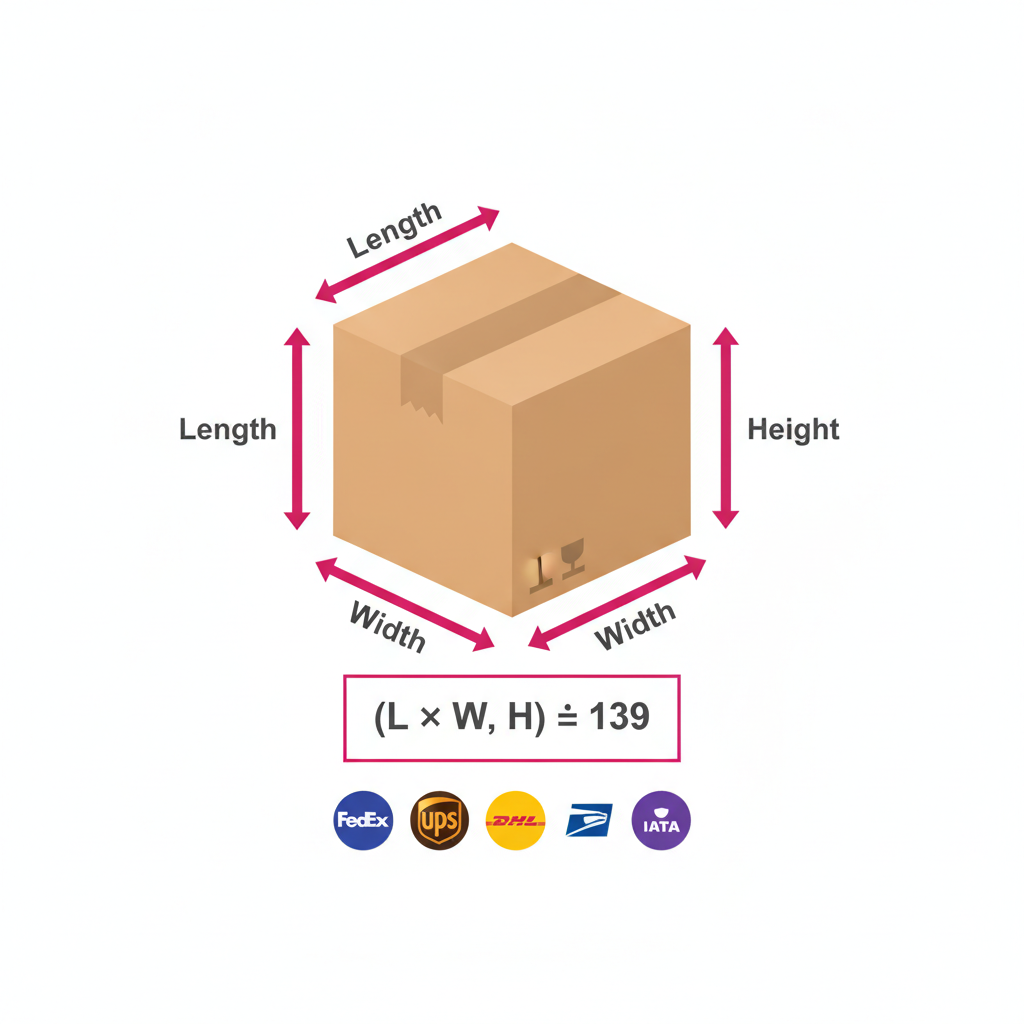
Dimensional weight (DIM weight) is a pricing method carriers use to bill lightweight, bulky shipments based on the space they occupy rather than their actual weight. If your packages take up a lot of room in a truck or aircraft but weigh very little, carriers charge you for the volume, not the scale weight.
The formula is the same everywhere, only the divisor changes: DIM weight = (Length × Width × Height) ÷ DIM divisor. Every major carrier — FedEx, UPS, DHL, USPS and IATA air cargo — uses its own divisor, which is why the same box can cost different amounts to ship depending on who carries it. The number you actually pay for is the chargeable weight, which is the greater of the actual weight and the dimensional weight.
Enter your package dimensions and actual weight, choose your carrier, and the calculator returns the dimensional weight and the chargeable weight instantly.
Here is how each carrier calculates dimensional weight. The example column uses a 24″ × 18″ × 12″ box weighing 8 lbs actual.
| Carrier | Formula | Divisor | Applies to | Example (24×18×12, 8 lbs) |
|---|---|---|---|---|
| FedEx | (L × W × H) ÷ 139 | 139 (inches) | All packages over 1 cubic foot | 38 lbs |
| UPS | (L × W × H) ÷ 139 | 139 (inches) | Same as FedEx | 38 lbs |
| DHL Express | (L × W × H) ÷ 5000 | 5000 (cm³/g) | Metric, result in kg | 17.0 kg |
| USPS Priority Mail | (L × W × H) ÷ 166 | 166 (inches) | Priority Mail only; First Class exempt | 32 lbs |
| IATA Air Cargo | (L × W × H) ÷ 6000 | 6000 (cm³/g) | Industry standard for air freight | 14.2 kg |
This box has a cubic volume of 5,184 cubic inches (or 84,934 cm³ once converted to metric). Its actual weight of 8 lbs equals about 3.63 kg. Watch how the chargeable weight changes by carrier:
Notice that the same physical box is billed as 38 lbs by FedEx, 32 lbs by USPS, and 17 kg (about 37.5 lbs) by DHL. A single measurement error of even one inch on any side ripples straight into these figures — and into your invoice.
Because chargeable weight is driven by volume, dimensioning errors are billing errors. Rounding 24″ up to 25″ on one side alone can push a shipment into a higher rate. Multiply that across thousands of parcels or pallets a day and manual tape-and-clipboard measurement quietly bleeds revenue — either you overpay carriers or you undercharge your own customers and eat the difference.
This is where automated dimensioning eliminates the guesswork. CubiQ ONE captures exact length, width and height of static parcels at the packing station in seconds. CubiQ LINE measures parcels in motion directly on the conveyor without stopping the flow. CubiQ X dimensions pallets and irregular freight for LTL and air cargo billing. Each system records certified L×W×H at the dock, so the dimensional weight you calculate is the dimensional weight the carrier calculates — ending billing disputes and DIM weight leakage for good.
Multiply length × width × height to get the cubic volume, then divide by your carrier's DIM divisor. Compare the result to the package's actual weight; the higher of the two is the chargeable weight you pay for.
FedEx divides the cubic size in inches (L × W × H) by 139. It applies dimensional weight to all packages larger than one cubic foot, and rounds the result up to the next whole pound.
UPS uses the same formula as FedEx: (L × W × H) in inches ÷ 139, rounded up to the next pound. The chargeable weight is the greater of the actual and dimensional weight.
Air freight follows the IATA standard: (L × W × H) in centimeters ÷ 6000, giving a result in kilograms. This 1:6000 factor is the global benchmark for air cargo chargeable weight.
Yes, but only for Priority Mail and Priority Mail Express packages larger than one cubic foot shipped to certain zones. USPS divides cubic inches by 166. First Class Package Service is exempt from dimensional weight.
DHL Express uses the metric formula (L × W × H) in centimeters ÷ 5000, producing a result in kilograms. The chargeable weight is the higher of the dimensional weight and the actual weight.
_vector.svg)