
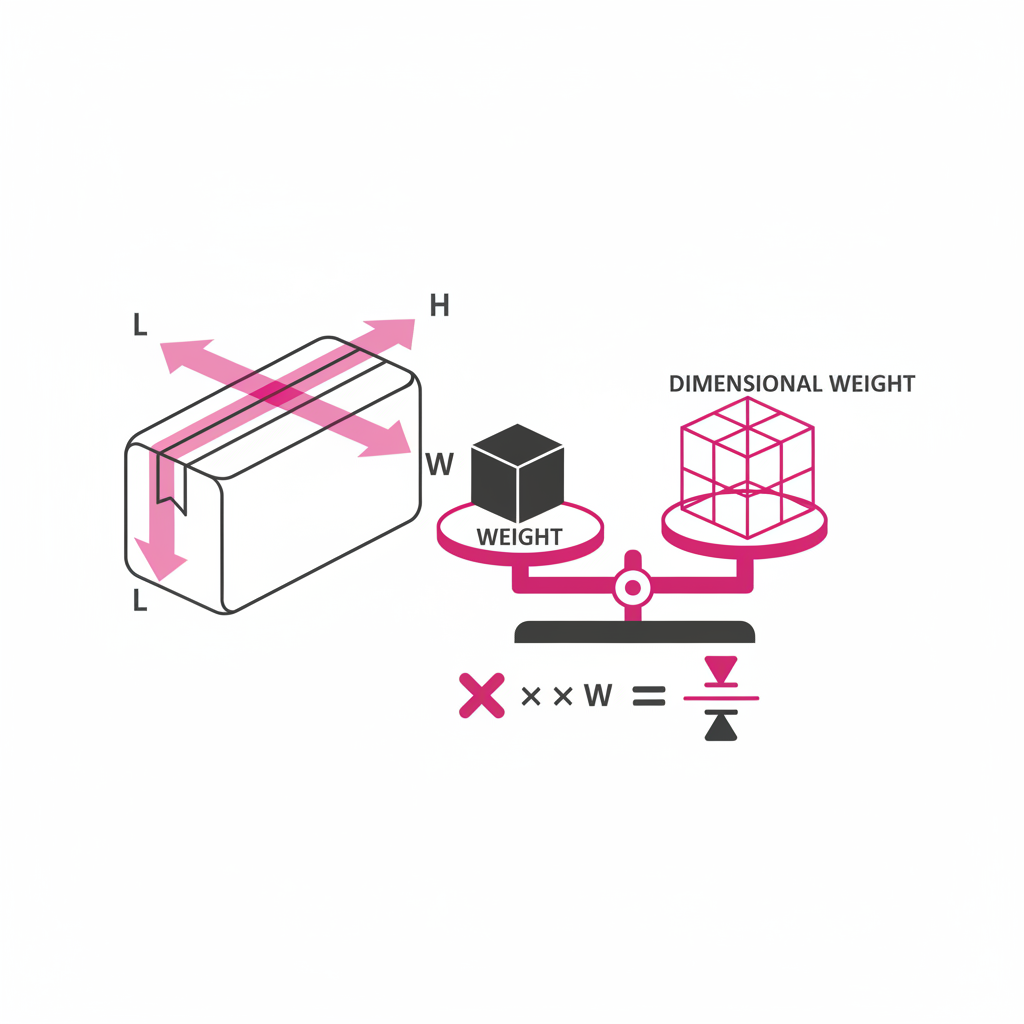
Quick answer: Dim weight (dimensional weight) is the weight a carrier assigns to a shipment based on its size: L × W × H ÷ DIM factor. If the dim weight is higher than the actual weight, the carrier bills the dim weight. Carriers that measure every shipment with an automated dimensioner recover revenue lost to under-declared dimensions.
Dimensional weight (DIM weight) is a pricing method used by carriers and freight companies that charges based on the space a package occupies rather than just its actual weight. The formula is simple:
DIM Weight = (Length × Width × Height) ÷ DIM Factor
The carrier charges the higher of actual weight or DIM weight. For light, bulky packages — common in e-commerce, retail, and pharmaceutical logistics — DIM weight almost always wins, meaning shippers pay for cube, not mass.
For carriers and freight forwarders, the risk runs in the opposite direction: if outbound shipments are measured incorrectly — or not measured at all — dimensional weight is calculated from shipper-declared data, which is frequently wrong.
Industry studies show that 20–40% of parcels in courier and 3PL networks have incorrect dimensional data on file. The result:
A dimensional weight scanner measures length, width, and height in real time and applies the carrier's DIM factor automatically, generating a certified DIM weight used for billing instead of shipper-declared data.
When integrated with a scale, the system compares actual weight and DIM weight instantly and charges the higher value — every time, with no human intervention and no rounding errors.
CubiQ ONE and CubiQ LINE are dimensional weight scanners certified to ±2 mm accuracy. Each scan generates a tamper-proof record including dimensions, actual weight, DIM weight, barcode, and HD photo — all timestamped and available via API for integration into billing platforms.
| Type | Best For | Typical Accuracy |
|---|---|---|
| Parcel dimensioner | Boxes, bags, small items under 150 cm | ±1–2 mm |
| Freight dimensioner | Mixed freight, crates, non-conveyable items | ±3–5 mm |
| Pallet dimensioner | Pallet loads, oversized cargo | ±5–10 mm |
For a mid-sized courier processing 5,000 parcels per day:
The fastest path to implementation is a single-station deployment at the inbound intake point, where all freight is measured before it enters the network. From that point, DIM weight data flows automatically into your TMS or billing platform and becomes the authoritative record for every shipment.
CubiQ offers a free measurement audit — bring 20 representative shipments and we'll show you exactly how much dimensional weight revenue you are currently leaving on the table.
Dim weight is a billing method that charges for the space a shipment occupies in a truck, container or aircraft. It protects carriers from large, light packages that would otherwise be billed far below the capacity they consume.
Vehicle and aircraft capacity is limited by volume as much as by mass. Dimensional weight pricing aligns the price of a shipment with the capacity it uses, which is why FedEx, UPS, USPS, DHL and air cargo carriers all apply it.
Revenue leaks when shipments are billed on shipper-declared dimensions, when manual measurements are skipped at peak times, or when measurements are rounded down. Each error is small, but across thousands of shipments it becomes a significant share of revenue.
A dimensional weight system combines a dimensioner, a scale and software to measure each shipment, calculate dim and billable weight automatically, and send the result to billing. CubiQ systems do this in 1–2 seconds with photo evidence for every record.
Results vary by shipment mix, but CubiQ customers report up to 20% DIM weight revenue recovered at parcel stations and up to 25% fewer billing disputes with pallet dimensioning.
Last updated: September 30, 2026. Specifications reflect current CubiQ product data.
_vector.svg)