
A dimensioning system that captures measurements and stores them locally has limited value. The measurement happens in under two seconds. What happens in the next two seconds determines whether that data improves your operations or disappears into an offline log.
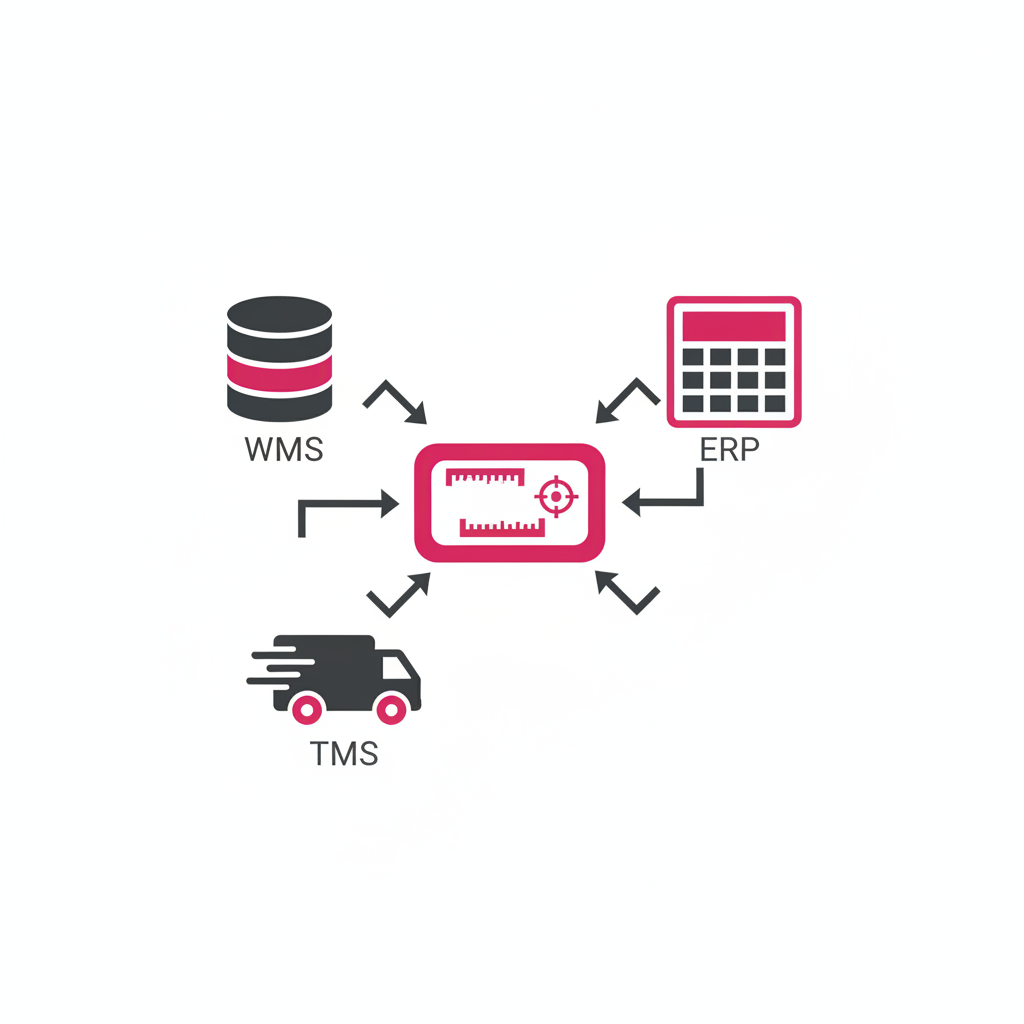
The difference between a dimensioning system that pays for itself in 12 months and one that sits underused is integration. When dimension data flows automatically to the WMS, TMS, and ERP in real time, it triggers downstream workflows without human intervention: freight class calculation, carrier billing, putaway slot assignment, and audit record creation all happen from a single scan event.
A typical dimensioning integration stack involves four components:
Most commercial dimensioning systems include a manufacturer-provided middleware application (often called a measurement server or data server) that handles sensor communication and exposes a configurable output API. Integration work happens between this middleware and the target WMS or TMS.
The WMS is typically the primary integration target for dimensioning systems in warehouse environments. The most common integration points are:
When freight arrives and is scanned at the dimensioner, the system retrieves the associated purchase order or ASN from the WMS using the barcode or license plate number. It writes verified L, W, H, and weight to the item or pallet record, replacing any estimated dimensions that may have been carried from the PO.
This is critical for operations where vendor-supplied item master dimensions are frequently inaccurate. Verified receiving dimensions ensure that WMS slot recommendations are based on actual, not estimated, pallet or carton sizes.
With accurate dimensions in the WMS, the slotting algorithm can recommend appropriate storage locations based on the actual volume and height of the incoming pallet. Operations using directed putaway see immediate reduction in slot rejections (where a forklift operator arrives at the assigned slot only to find the pallet does not fit).
In pick-face operations, carton dimensions from the dimensioner can inform the WMS about how many units fit in a pick slot, enabling more accurate replenishment triggers based on slot volume rather than unit count alone.
Compatible WMS platforms include SAP EWM, Manhattan Associates WMS, Blue Yonder (formerly JDA), Oracle WMS Cloud, Infor WMS, Korber WMS, and most mid-market WMS platforms with REST API or EDI capabilities.
For operations with outbound LTL or parcel shipping, TMS integration is where dimensioning delivers the most immediate financial return.
When a pallet is scanned at the outbound dock, the dimensioner passes L, W, H, and weight to the TMS. The TMS calculates density and looks up the corresponding NMFC freight class. The rated class is applied to the shipment before the carrier pickup request is generated.
This automated calculation replaces manual freight class lookup (error-prone) or carrier-estimated class (frequently unfavorable to the shipper).
With accurate dimensions, the TMS can perform more accurate rate shopping across carriers. Carriers with aggressive density-based pricing structures may offer better rates for specific shipment profiles that only become apparent when dimensions are known precisely.
Verified dimensions flow directly into the bill of lading (BOL) and shipping label, ensuring declared dimensions match what the carrier will measure at their dock. This eliminates the re-weigh and reclassification adjustments that occur when declared and measured dimensions differ.
Compatible TMS platforms include Oracle TMS, SAP TM, MercuryGate, Descartes, project44, and most 3PL TMS environments with API-accessible shipment records.
ERP integration typically focuses on item master enrichment and cost allocation:
Compatible ERP platforms include SAP S/4HANA, Oracle Fusion, Microsoft Dynamics 365, and NetSuite, typically integrated via REST API or batch file exchange.
Real-time, bidirectional integration. The dimensioner middleware calls the WMS/TMS API to retrieve shipment context and post measurements. This is the preferred integration method for systems that support it, as it enables real-time data flow and error feedback.
Event-driven integration where the dimensioner posts a measurement payload to a configured URL immediately after each scan. The receiving system processes the payload asynchronously. Simpler to configure than full API integration but requires the receiving system to expose a webhook endpoint.
Batch integration where the dimensioner middleware writes measurement records to a shared file location at defined intervals. The WMS or ERP polls the file location and imports records. Suitable for legacy systems that do not support API or webhook integration, but introduces latency (measurements are not available in real time).
A standard REST API integration between a dimensioner and a major WMS platform typically takes 2-6 weeks for development and testing, assuming the WMS has a documented API and the dimensioner vendor provides an integration guide. Flat-file integrations can be completed in 1-2 weeks. Custom ERP integrations vary significantly based on the ERP configuration.
Established dimensioning vendors typically provide pre-built connectors for the most common WMS and TMS platforms. Ask the vendor for a certified integration list before purchase. Pre-built connectors significantly reduce integration project time and cost.
Standard output fields include: length, width, height (each in mm or inches), weight (in kg or lbs), volume (in cubic cm or cubic feet), barcode or SSCC, timestamp, operator ID, and a measurement confidence score. Some systems also output a 3D point cloud or photographic image of each measurement for dispute documentation.
Yes, some dimensioning middleware platforms support direct integration with carrier APIs (UPS, FedEx, DHL) to submit shipment data including dimensions at the time of scan. This is less common than WMS/TMS integration but is used in high-volume parcel operations where TMS overhead is unnecessary.
_vector.svg)