
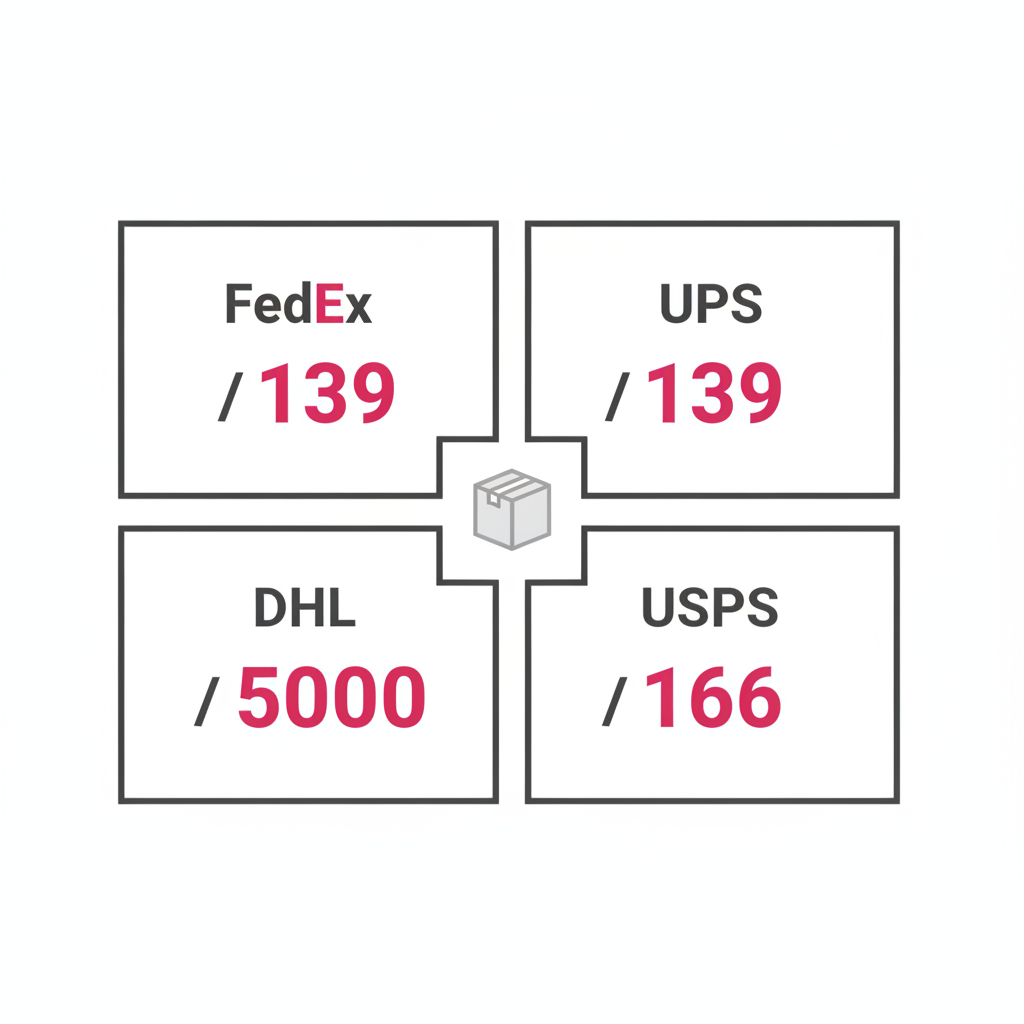
Dimensional weight (DIM weight) was created because a large, lightweight package takes up as much truck or aircraft space as a heavy one. Carriers introduced DIM weight pricing to ensure they are compensated based on the space a shipment occupies, not just its actual weight. The formula is straightforward: multiply the length, width, and height of the box, then divide by a carrier-specific divisor. The higher result — actual weight or DIM weight — becomes the chargeable weight.
The problem for shippers is that each carrier uses a slightly different divisor, applies the rule under different conditions, and exempts certain service types. If you're shipping with multiple carriers, those differences translate directly into billing surprises.
| Carrier | Formula (imperial) | Divisor | Metric equivalent | Applies when | Key exception |
|---|---|---|---|---|---|
| FedEx | (L × W × H in.) ÷ 139 | 139 | ÷ 5,000 (cm³/kg) | All packages; Ground only if >1 cu ft | FedEx One Rate packages exempt |
| UPS | (L × W × H in.) ÷ 139 | 139 | ÷ 5,000 (cm³/kg) | All packages where DIM > actual weight | None — rounds up to nearest lb |
| DHL Express | (L × W × H in.) ÷ 305 | 305 | ÷ 5,000 (cm³/kg) | All shipments, always | None — no minimum size threshold |
| USPS | (L × W × H in.) ÷ 166 | 166 | N/A | Priority Mail & Priority Mail Express >1 cu ft | First Class Package and Ground Advantage exempt |
| IATA (air cargo) | (L × W × H cm) ÷ 6,000 | 6,000 | ÷ 6,000 (cm³/kg) | All air cargo shipments | Individual airline agreements may vary |
Let's use a single box — 18 inches × 14 inches × 10 inches, actual weight 6 lbs — and calculate what each carrier charges.
Volume: 18 × 14 × 10 = 2,520 cubic inches
The same physical box generates chargeable weights ranging from 6 lbs to 19 lbs depending on the carrier and service. On a high-volume shipping operation, these differences compound into thousands of dollars per month.
FedEx uses the formula (L × W × H in inches) ÷ 139 to arrive at dimensional weight in pounds. This divisor has been in place since 2015, when FedEx aligned with UPS and lowered the Ground divisor from 166 to 139, effectively raising DIM weight charges across the board.
For FedEx Ground and FedEx Home Delivery, dimensional weight applies only when the package exceeds one cubic foot (1,728 cubic inches). Below that threshold, only actual weight is used. For FedEx Express services, DIM weight applies to every package regardless of size.
The one notable exception is FedEx One Rate flat-rate packaging. Shipments using FedEx One Rate envelopes, paks, boxes, or tubes are billed at a flat rate and are not subject to dimensional weight calculations.
UPS applies the same formula as FedEx: (L × W × H in inches) ÷ 139. Prior to 2015, UPS used a divisor of 166 for Ground shipments. The shift to 139 aligned all major domestic carriers on a common standard and increased effective rates for large, light packages.
UPS applies dimensional weight to all package services — Ground, Air, and International — whenever the calculated DIM weight exceeds actual weight. UPS rounds the result up to the nearest whole pound, so any fractional pound triggers the next billing increment. There are no flat-rate exemptions equivalent to FedEx One Rate in the standard UPS portfolio.
DHL Express uses a different scale than domestic US carriers. In metric: (L × W × H in cm) ÷ 5,000 = dimensional weight in kg. In imperial: (L × W × H in inches) ÷ 305 = dimensional weight in lbs.
The DHL divisor of 305 (imperial) is meaningfully lower than FedEx/UPS's 139, which means DHL's DIM weight result is higher for the same box. However, DHL Express operates primarily in the international express segment, where dimensional weight has always applied universally — there is no minimum cubic footage threshold. Every DHL Express shipment is assessed for dimensional weight regardless of size, and the higher of actual or DIM weight is billed.
For DHL's freight and cargo services (DHL Freight, DHL Air Freight), the IATA standard of dividing by 6,000 (cm³/kg) is typically applied, consistent with the rest of the air cargo industry.
Yes — but with important limitations that make USPS more forgiving than private carriers for certain shipment types.
USPS applies dimensional weight to Priority Mail and Priority Mail Express packages, using the formula (L × W × H in inches) ÷ 166. Crucially, DIM weight only kicks in if the package exceeds one cubic foot (1,728 cubic inches). Below that threshold, only actual weight applies.
First Class Package Service and USPS Ground Advantage are not subject to dimensional weight at all. These services bill purely on actual weight. For small, lightweight, high-volume shippers — especially e-commerce sellers shipping items in small boxes — this makes USPS Ground Advantage a cost-effective option where DIM weight is not a factor.
For air freight outside of express parcel carriers, the industry standard is set by the International Air Transport Association (IATA). The IATA formula is: (L × W × H in cm) ÷ 6,000 = dimensional weight in kg. This is known as the 1:6000 volumetric factor — meaning one kilogram of chargeable weight is assigned for every 6,000 cm³ of volume.
Most commercial airlines and air cargo forwarders apply this standard, though some negotiated contracts between airlines and large-volume shippers may use different factors. Always verify the applicable divisor with your freight forwarder before quoting a shipment.
Understanding carrier rules is only half the equation. The other half is ensuring that the dimensions you submit are accurate. Manual measurement with a tape measure introduces human error — and even a one-inch discrepancy on length, width, or height can shift a package into a higher billing tier when multiplied across thousands of shipments per day.
Billing disputes with carriers are costly: they consume staff time, trigger audits, and erode margin. The most effective defense is automated measurement at the point of induction.
CubiQ dimensioning systems — including the CubiQ ONE for static parcel measurement, the CubiQ LINE for high-speed conveyor environments, and the CubiQ X for pallet and freight dimensioning — capture L×W×H automatically and feed certified, auditable data directly to your carrier billing and WMS systems. When every measurement is accurate and timestamped, dimensional weight disputes disappear before they start.
_vector.svg)