
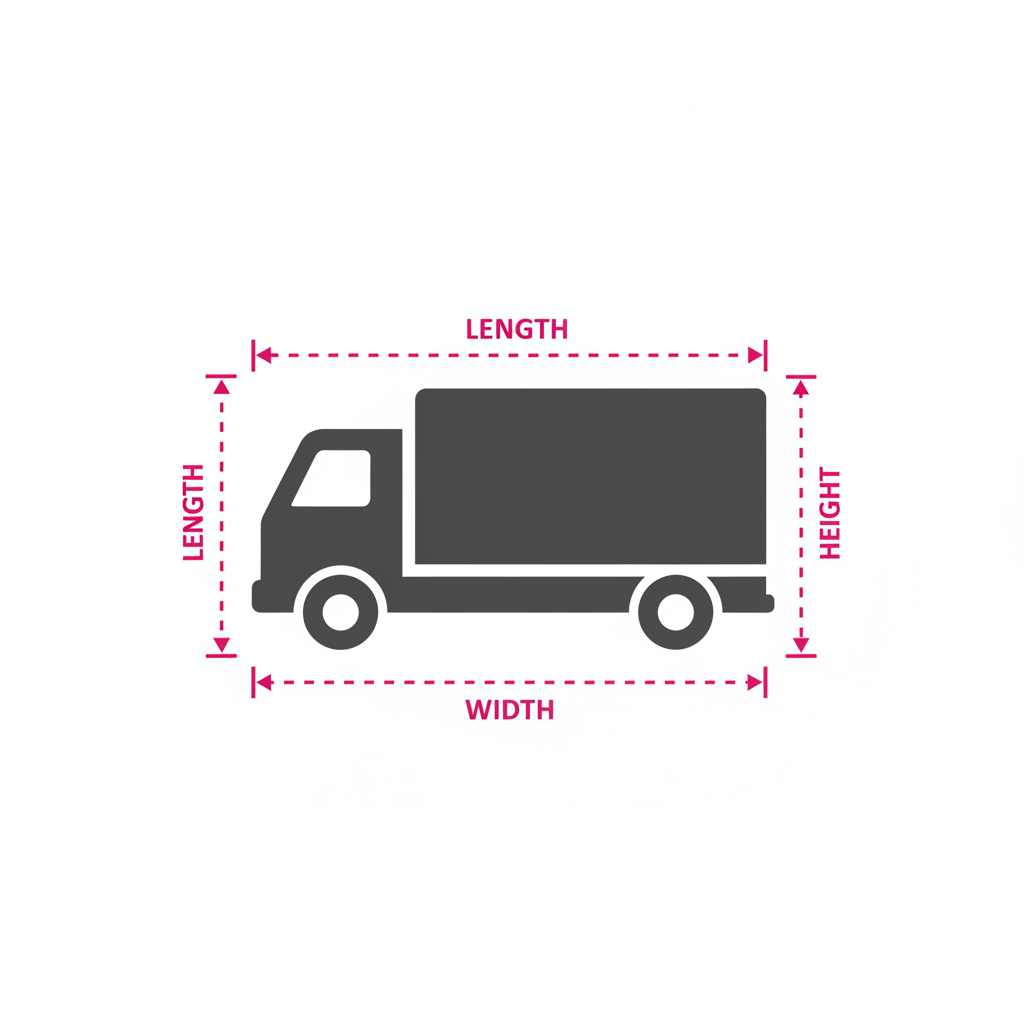
Quick answer: A freight dimensioner is a pallet-scale measuring system that captures the length, width, height and weight of palletized or oversized freight in a few seconds. LTL carriers, freight forwarders and air cargo terminals use freight dimensioners to calculate density-based freight class, IATA chargeable weight and to back invoices with photo evidence.
Freight dimensioning is the process of measuring the length, width, and height of palletized shipments and oversized freight to calculate dimensional weight and determine the correct freight class or billable weight. It applies primarily to LTL (less-than-truckload), FTL, and air cargo operations.
Unlike parcel dimensioning — where packages are typically regular in shape and move through automated conveyor systems — freight dimensioning must account for pallets, stacked loads, irregular shapes, and large variances in load geometry.
Carriers use freight dimensions for two purposes:
| Shipment Type | DIM Factor (inches) | Standard |
|---|---|---|
| Domestic parcel (UPS/FedEx) | 139 | Carrier-defined |
| Air freight | 166 (1:6000) | IATA |
| LTL freight | 250–360 (varies) | NMFC / carrier tariff |
| International air cargo | 166 (1:6000) | IATA |
Automated freight dimensioners use 3D sensor arrays to capture pallet dimensions in under 3 seconds — without stopping the forklift. The system records the bounding box of the entire load, integrates with your WMS or TMS, and produces a certified measurement record that can be used in billing disputes.
CubiQ offers two systems for freight and pallet dimensioning:
| System | Type | Measuring range (per edge) | Scan time | Throughput |
|---|---|---|---|---|
| CubiQ ONE | Static parcel dimensioner | 2 in – 31 in | < 1 second | Up to 360 packages/hour |
| CubiQ LINE | In-motion conveyor dimensioner | 2 in – 32 in | 1 second | Up to 3,600 packages/hour |
| CubiQ X / XL | Pallet and oversized freight dimensioner | 12 in – 79 in | 2 seconds | Up to 120 pallets/hour |
| CubiQ DTPS | Drive-through pallet scanner | 19 in – 118 in | 2 seconds | Up to 250 pallets/hour |
All CubiQ systems capture dimensions, weight, barcodes, label text (OCR) and HD photo evidence in one scan, and push records to WMS, ERP and TMS platforms via REST API and webhooks.
A freight dimensioner is a frame-mounted or drive-through scanner sized for pallets, crates and irregular freight. It measures the full envelope of the load, including overhang, and records weight and photos so carriers bill on verified data rather than declared dimensions.
LTL carriers use freight dimensioners to calculate shipment density (pounds per cubic foot), which drives freight class under density-based classification. Automated measurement catches misclassified shipments and supports reclass invoices with a timestamped photo.
Air cargo is billed on chargeable weight: the higher of actual weight and volumetric weight. IATA volumetric weight is L×W×H in cm divided by 6,000. A freight dimensioner computes both values automatically at acceptance.
A drive-through dimensioner scans the pallet while the forklift keeps moving. CubiQ DTPS captures dimensions, weight, barcodes and photos in about 2 seconds and processes up to 250 pallets per hour, with optional dynamic weighing on the forklift forks.
Dark or reflective wrap can defeat some optical sensors. CubiQ XL is designed specifically to read black-wrapped pallets reliably; ask any vendor to demo on your own wrapped freight.
Last updated: September 30, 2026. Specifications reflect current CubiQ product data.
_vector.svg)