
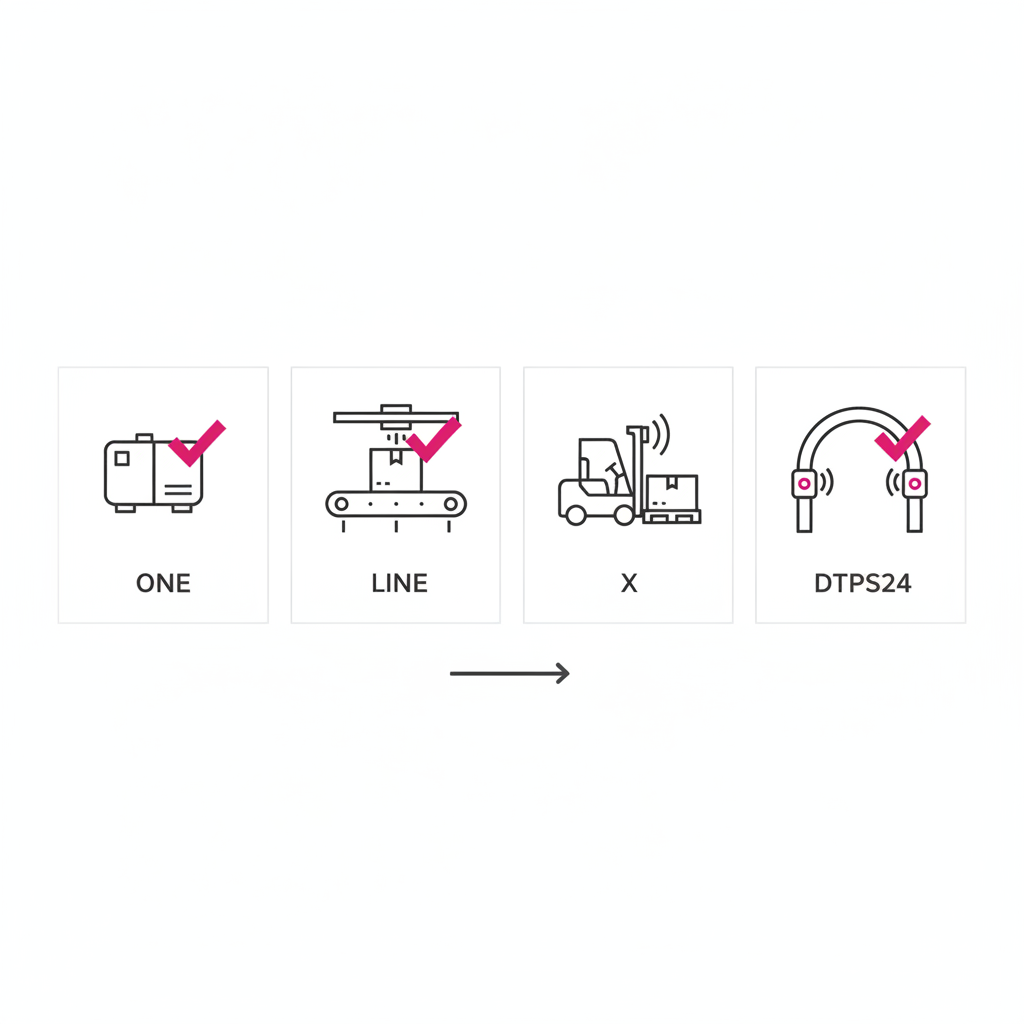
Every year, logistics operators leave significant revenue on the table — not because of poor routing or high carrier rates, but because of inaccurate dimensional weight (DIM weight) capture. When a parcel's chargeable weight is undercalculated by even 3%, the cumulative billing gap across thousands of daily shipments becomes a material loss. A dimensioning system closes that gap automatically.
Beyond revenue recovery, the right system accelerates dock-to-stock time, reduces manual data entry errors, and feeds clean data into your WMS, ERP, or shipping platform. But not every operation needs the same solution. A small regional courier has entirely different requirements than a high-volume 3PL processing 10,000 parcels per shift on an automated conveyor line.
This guide gives logistics directors and operations managers a structured, five-criterion framework to evaluate dimensioning systems — and maps each criterion to the right CubiQ product.
The most important starting point is how many items you need to measure per hour. Throughput determines whether you need a static station, an in-motion conveyor system, or a drive-through scanner.
Dimensioning systems are engineered for specific object categories. Using the wrong system type results in lower accuracy, slower processing, or failed integration with downstream systems.
A dimensioning system that cannot talk to your warehouse management system (WMS) or enterprise resource planning (ERP) platform creates a data silo. Look for systems that support open APIs, standard data formats (XML, JSON, CSV), and pre-built connectors for common platforms such as SAP, Oracle WMS, Manhattan Associates, or CargoWise.
Integration requirements should be defined before procurement, not after. Confirm: What events trigger a dimension capture? Where does the data land? What happens on a scan failure?
The physical installation model must match your facility layout and workflow design. Key questions include: Is there an existing conveyor belt that can host a frame-mounted system? Is there a dedicated manual scanning station? Do forklifts need to pass through without stopping?
Quantify the financial return before selecting a system. The two primary ROI drivers are DIM weight revenue recovery and labor cost reduction from eliminating manual measurement.
A simple payback model: If your operation ships 1,000 parcels per day at an average chargeable weight of 5 kg, and your current manual process has a 3% DIM weight error rate, you are systematically under-billing on 30 parcels per day. At an average rate of $0.80/kg for the uncaptured dimensional weight, that is $24/day or roughly $8,700 per year — from a single station. At higher volumes, the recovery scales proportionally.
| Product | Throughput | Shipment Type | Integration | Footprint | Best For |
|---|---|---|---|---|---|
| CubiQ ONE | Up to 500 items/hr | Individual parcels | API, CSV, WMS connectors | Standalone station | Small/mid couriers, retail shipping desks |
| CubiQ LINE | 500–5,000+ items/hr | Individual parcels, polybags | API, sortation system integration | Conveyor-mounted frame | High-volume sortation lines, e-commerce 3PLs |
| CubiQ X / X-XL | Pallet-level | Pallets, irregular freight | API, ERP, CargoWise | Fixed scanning station | Freight carriers, LTL operators, air cargo |
| CubiQ DTPS24 | Pallet-level, continuous flow | Pallets, bulk loads | API, WMS, ERP | Drive-through portal | Large warehouses, 3PLs, dock receiving |
Scenario: A regional courier processes 1,000 parcels per day. Manual measurement has a 3% error rate on DIM weight capture. Average uncaptured DIM weight per error: 1.2 kg. Average revenue per kg: $0.75.
A CubiQ ONE system typically pays back in under 12 months at this volume. At higher throughput levels, payback periods shorten significantly.
Warehouse automation refers to any technology that replaces manual labor with machines or software in warehouse operations — from conveyor systems and autonomous robots to barcode scanners and dimensioning systems. Dimensioning is one of the highest-ROI automation investments because it directly links to billing accuracy and revenue recovery.
By automatically capturing length, width, height, and weight in under one second, a dimensioner eliminates the need for manual measurement at receiving, shipping, or sorting stations. One system can replace 2–4 FTEs across a single shift, depending on volume and workflow design.
CubiQ Technologies offers a full product line covering parcel, pallet, and freight dimensioning — from static stations (CubiQ ONE) to high-speed conveyor systems (CubiQ LINE) and drive-through pallet scanners (CubiQ DTPS24). All systems include API integration for WMS, ERP, and carrier billing platforms.
Static systems like CubiQ ONE can be operational within hours. Conveyor-integrated systems (CubiQ LINE) typically require 1–3 days for mechanical installation plus integration testing. Drive-through portals (CubiQ DTPS24) require facility assessment before installation timeline can be confirmed.
Industrial dimensioning systems should achieve ±2mm or better on length, width, and height at rated throughput. CubiQ systems meet OIML and NTEP certification standards for legal-for-trade applications where required.
_vector.svg)