
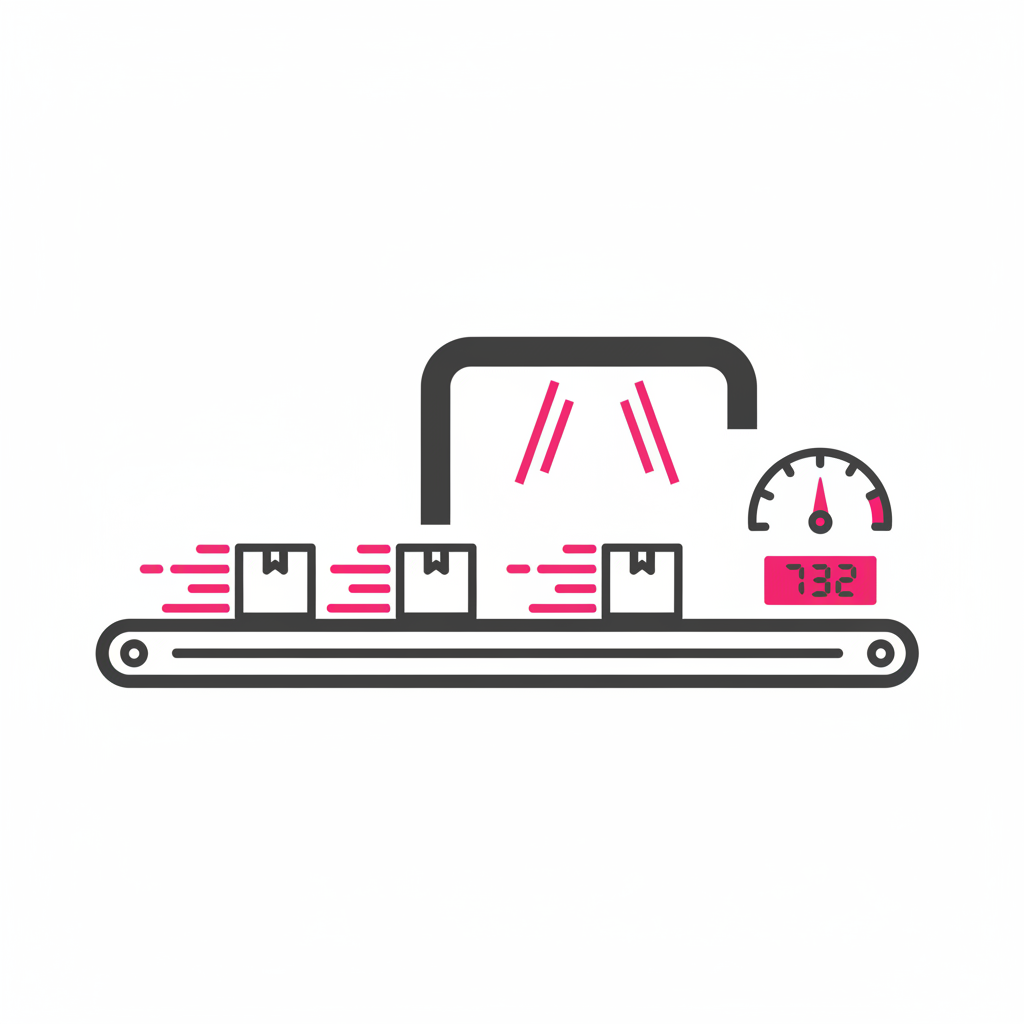
In-motion dimensioning is the process of measuring the length, width, and height of packages as they move along a conveyor belt at normal operating speed. Unlike static dimensioning (where a forklift stops in front of a kiosk or an operator places a parcel on a measurement platform), in-motion systems capture all three dimensions in under 100 milliseconds as each package passes through the measurement zone, without interrupting material flow.
This capability is critical for sortation operations where stopping the conveyor for measurement is not operationally feasible. A parcel sortation line running at 2 m/s with 3,000-8,000 packages per hour cannot afford a 2-second stop per package. In-motion dimensioning solves this by integrating measurement directly into the conveyor flow.
Capturing accurate dimensions of an object moving at 1.5-3 m/s requires sensors capable of extremely high-speed data acquisition. The measurement window for a standard carton passing through the sensor field at 2 m/s is approximately 25-100 milliseconds, depending on package length. Within that window, the system must:
This is achieved through a combination of high-speed laser line scanners, time-of-flight sensors, or camera arrays, controlled by firmware that processes sensor data in real time. Consumer-grade 3D cameras cannot achieve the speed or accuracy required; commercial in-motion dimensioners use industrial-grade sensors purpose-built for this application.
The most common technology for high-accuracy in-motion dimensioning. A laser plane is projected across the conveyor, and a camera observes how the laser line deforms as packages pass through it. By scanning rapidly (1,000-4,000 Hz) and knowing the conveyor speed (from an encoder), the system reconstructs the full three-dimensional profile of the package surface.
Laser line scanner systems achieve accuracy in the +/-2mm range for packages moving at up to 3 m/s, which is within the billing tolerance required for most freight applications.
Multi-beam LiDAR arrays mounted above the conveyor sweep thousands of points across the package surface as it passes beneath them. LiDAR systems are well-suited for irregular packages and packages with non-flat tops (such as polybags or envelope-style shipments) because they capture a dense point cloud rather than a single laser profile.
Arrays of synchronized cameras capture stereoscopic images of the passing package and reconstruct a 3D surface model. Lower cost than LiDAR, but performance can degrade on dark, reflective, or transparent packages, and accuracy is typically in the +/-3-5mm range rather than +/-2mm.
In-motion dimensioning does not operate in isolation. In a sortation environment, the dimension measurement is one of several data points captured at the same moment:
Data from the dimensioner, barcode reader, and checkweigher is consolidated by the sorter control system (typically a WCS or WMS-integrated sortation controller) and pushed to the TMS or carrier manifesting system before the package reaches the sorting divert point.
In-motion dimensioning systems have rated throughput ranges based on conveyor speed and minimum package gap:
Minimum gap requirements are critical for in-motion systems because the system must correctly identify where one package ends and the next begins. Sortation lines that run packages too close together (gap under the rated minimum) will see increased measurement errors or merged measurements.
In-motion dimensioning systems require more careful installation than static systems because measurement accuracy depends on precise alignment between the sensor array and the conveyor surface:
Commercial in-motion dimensioning systems rated for freight billing applications support conveyor speeds up to 3-3.5 m/s (approximately 700-800 ft/min). This covers the full speed range of most sortation conveyors, including high-speed crossbelt and shoe sorters.
Most systems handle regular cartons well. Performance on polybags, soft-sided parcels, and highly irregular shapes varies. LiDAR-based systems generally outperform laser line scanners on irregular shapes. Specify your freight profile to the vendor and request accuracy test data for non-rectangular packages.
Packages that generate a measurement outside the rated accuracy (typically flagged by the system's confidence score) are diverted to an exception lane for manual measurement or re-measurement. Most systems achieve successful measurement rates of 98-99.5% for standard cartons.
Most commercial in-motion systems are compatible with flat belt, modular belt, and roller conveyors. Crossbelt sorters and shoe sorters require integration with the sorter's encoder and divert control system. Spiral conveyors and inclined conveyors present mounting challenges that should be reviewed with the vendor before purchase.
_vector.svg)