
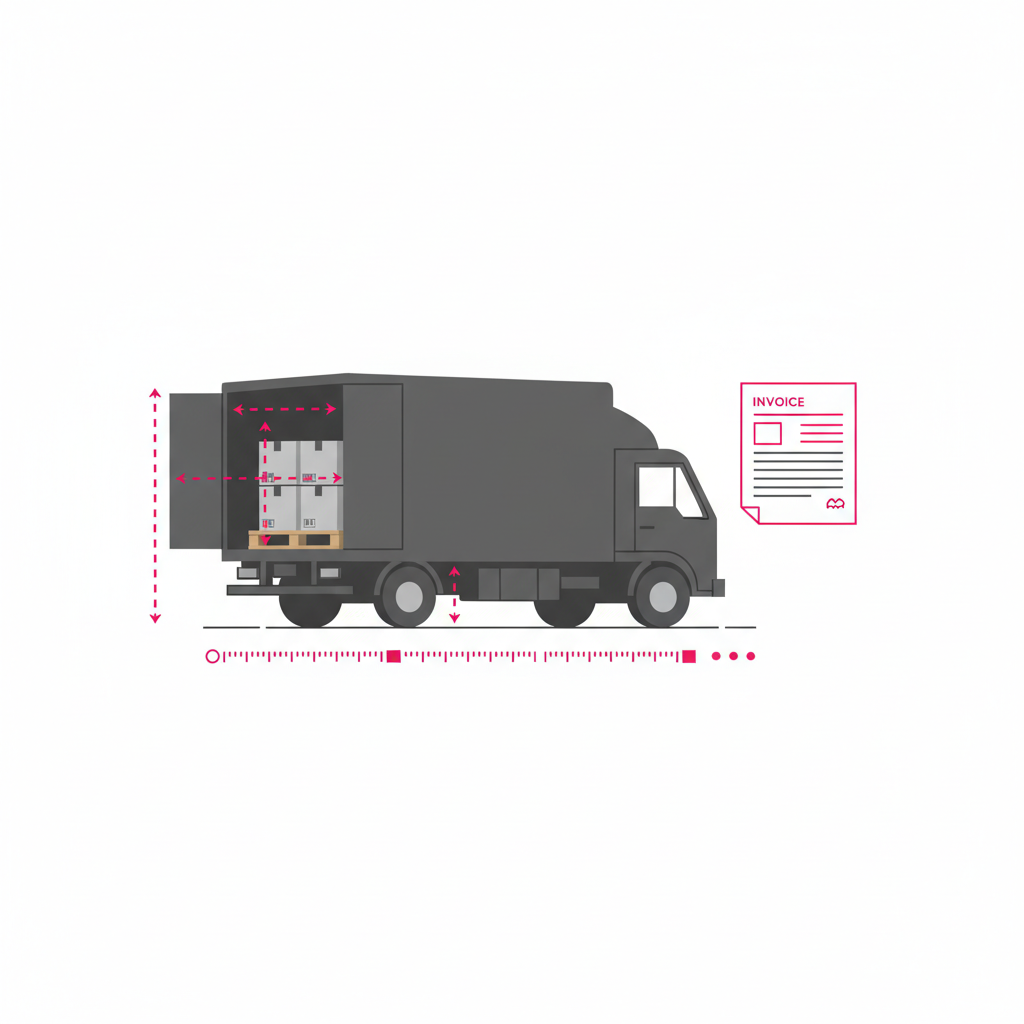
In less-than-truckload (LTL) shipping, every inch of freight directly determines how much a shipper pays. Unlike full truckload (FTL) freight — which is priced per mile — LTL pricing is built on freight class, which is calculated from density. Density is calculated from weight and volume. Volume comes from dimensions.
This cascade means a single inaccurate measurement at the dock can trigger a re-weigh, a reclassification, and a billing adjustment that arrives weeks after the shipment delivered. For carriers processing thousands of LTL shipments daily, unverified dimensions represent both revenue leakage and operational friction.
The National Motor Freight Classification (NMFC) system assigns every commodity a freight class from 50 to 500. Lower classes (denser, more stable freight) cost less to ship. Higher classes (lighter, bulkier, fragile, or hazardous freight) cost more.
For most commodities, freight class is determined by density:
Density = Weight / Volume. Volume = Length x Width x Height / 1,728 (to convert cubic inches to cubic feet).
When a carrier receives a pallet at the dock without verified dimensions, it must make a choice: accept the shipper's declared dimensions or measure the freight itself. Most large LTL carriers use dimensioning systems on their dock to audit incoming freight.
Common problems caused by unverified shipper dimensions:
Leading LTL carriers deploy automated dimensioning systems at their dock doors and sorting lines to measure every inbound pallet and parcel. These systems use structured light, LiDAR, or time-of-flight sensors to capture precise three-dimensional measurements in under one second.
At an LTL terminal, a dimensioning system typically:
For carriers handling 10,000 to 50,000 LTL shipments per day, this automation catches hundreds of misclassified or misdeclared shipments before they leave the dock — recovering revenue that would otherwise be lost.
Accurate dimensioning is not just a carrier concern. Shippers who measure freight at the point of origin capture several advantages:
LTL carriers handle both palletized freight and smaller parcels, and the dimensioning technology differs for each:
Pallet dimensioners are fixed or handheld systems that scan full pallets including overhang and irregular stacking. They are positioned at dock doors, check-in stations, or standalone kiosks. Accuracy requirements for freight billing are typically +/-5mm or better.
Parcel dimensioners are conveyor-mounted or in-motion systems designed for smaller packages moving at speed on sorting lines. They can measure hundreds of parcels per minute, associating dimensions with barcode reads in real time.
The carrier will re-weigh and re-measure the freight at their terminal. If the dimensions or weight differ from what was declared, a freight bill adjustment will be issued, usually appearing as a separate charge 1 to 3 weeks after delivery.
Freight class is based on density: Weight divided by Volume in cubic feet. Volume = L x W x H (in inches) divided by 1,728. The resulting pounds-per-cubic-foot value maps to a freight class on the NMFC density table. Lower density equals higher class equals higher rate per hundredweight.
Major LTL carriers use automated dimensioning at their primary terminals. Regional and smaller carriers vary in adoption. However, the trend is toward universal adoption as the technology cost has dropped and the revenue recovery value is well documented.
Commercial dimensioning systems certified for freight billing typically provide +/-2 to 5mm linear accuracy. For a standard LTL pallet, this translates to a volume variance of well under 1%, which is within industry tolerances for freight class calculation.
Yes. Most commercial dimensioning systems output measurements via API, webhook, or flat-file export that integrates with major TMS platforms. The integration is typically real-time, so freight class is calculated and applied to the shipment record at the time of measurement.
_vector.svg)