
Every shipment generates documents: bills of lading, airway bills, delivery receipts, customs declarations, packing lists. In most logistics operations, these documents are still processed manually — keyed in by clerks, filed in folders, and chased via email.
The cost is enormous. Manual data entry error rates run between 1–4%. At high volumes, this translates to thousands of mis-keyed records per month, delayed invoicing, customs holds, and proof-of-delivery disputes. Back-office automation with OCR is the direct solution to this problem.
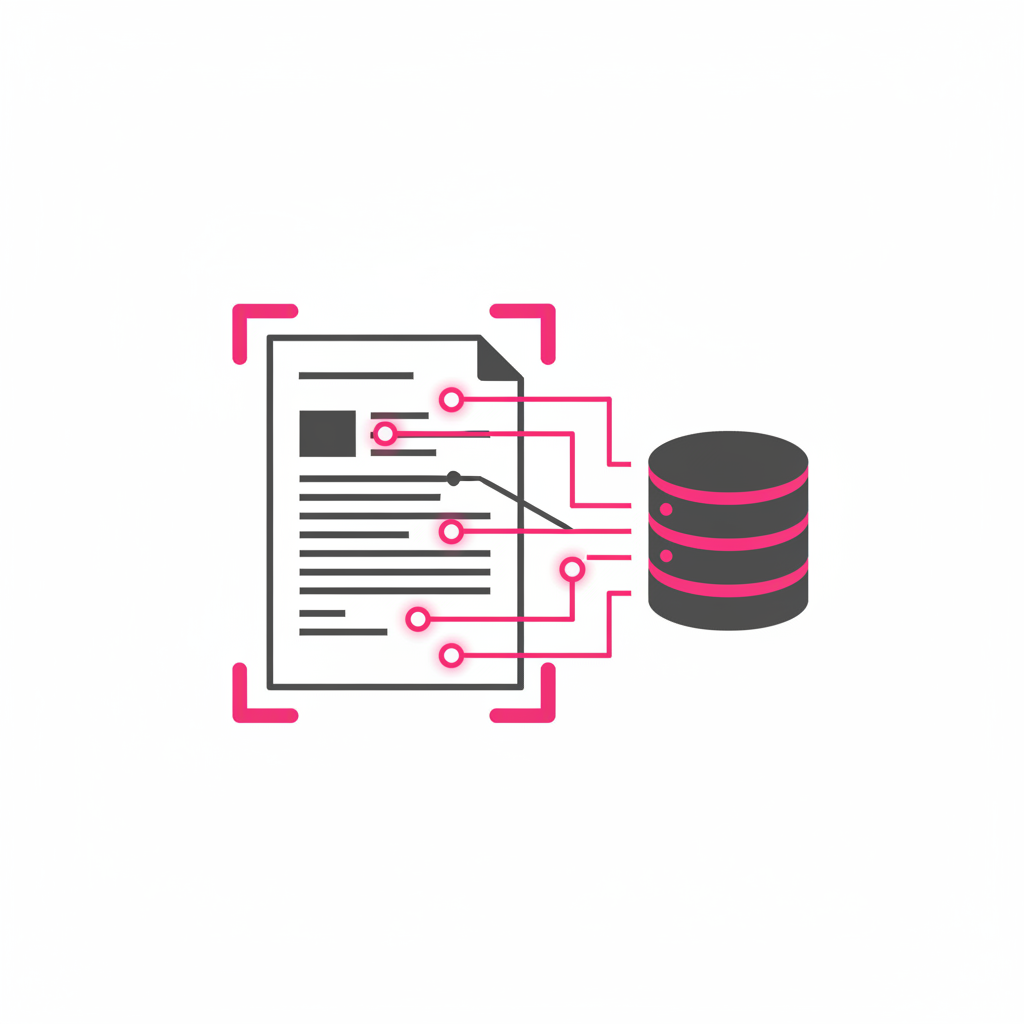
Automatic document recognition (ADR) uses optical character recognition (OCR) combined with AI document understanding models to extract structured data from unstructured documents. Instead of a clerk reading a waybill and typing the shipper's name, consignee address, and declared weight into a TMS, the system does it automatically in seconds.
Modern logistics OCR goes beyond basic character reading. AI-powered document recognition:
Carriers and freight forwarders receive hundreds of airway bills and bills of lading daily. OCR automation captures shipper, consignee, origin, destination, declared weight, and piece count from each document and pushes the data directly into the TMS or CargoWise without manual entry.
Proof-of-delivery (POD) documents are often paper-based and returned from drivers in batches. Automatic document recognition scans, classifies, and indexes these receipts upon arrival, making them searchable and dispute-ready within minutes instead of days.
Customs declarations require precise extraction of HS codes, declared values, and consignee information. OCR with validation logic catches errors before the declaration is submitted, reducing customs holds and penalty exposure.
Logistics OCR can extract line items from carrier invoices and automatically compare them against contracted rates — flagging overbillings, duplicate charges, and accessorial fees that fall outside agreed terms.
What makes CubiQ’s approach unique is the fusion of physical measurement and document recognition at the same scan point. When a package passes through a CubiQ LINE or CubiQ ONE station, the system simultaneously captures:
All three data streams are unified in a single record and pushed to the WMS or ERP via API. This eliminates the gap between the physical parcel and its paperwork — the root cause of most billing disputes and proof-of-delivery failures.
| Capability | Why It Matters |
|---|---|
| Document-type agnostic classification | Avoids the need to configure separate templates per document type |
| Handwriting recognition | Critical for PODs and manually completed customs forms |
| Multi-language support | Essential for cross-border freight |
| Validation and exception routing | Catches errors before they enter downstream systems |
| API-first architecture | Enables direct integration with TMS, WMS, CargoWise, SAP |
The term logtech describes the convergence of logistics operations with technology — sensors, AI, robotics, and data platforms. Document automation is one of the fastest-growing segments within logtech because it delivers measurable ROI without requiring physical infrastructure changes.
Companies that have implemented OCR-based back-office automation report:
The fastest path to implementation is identifying the two or three document types that consume the most manual effort in your operation today. For most freight operations, those are airway bills, delivery receipts, and carrier invoices.
CubiQ’s document AI module can be deployed as a standalone back-office automation layer or as part of an integrated dimensioning-plus-OCR station that handles physical measurement and document processing in a single step.
Request a demo to see live extraction accuracy on your own document types, and get a projected ROI estimate for your current monthly document volume.
_vector.svg)