
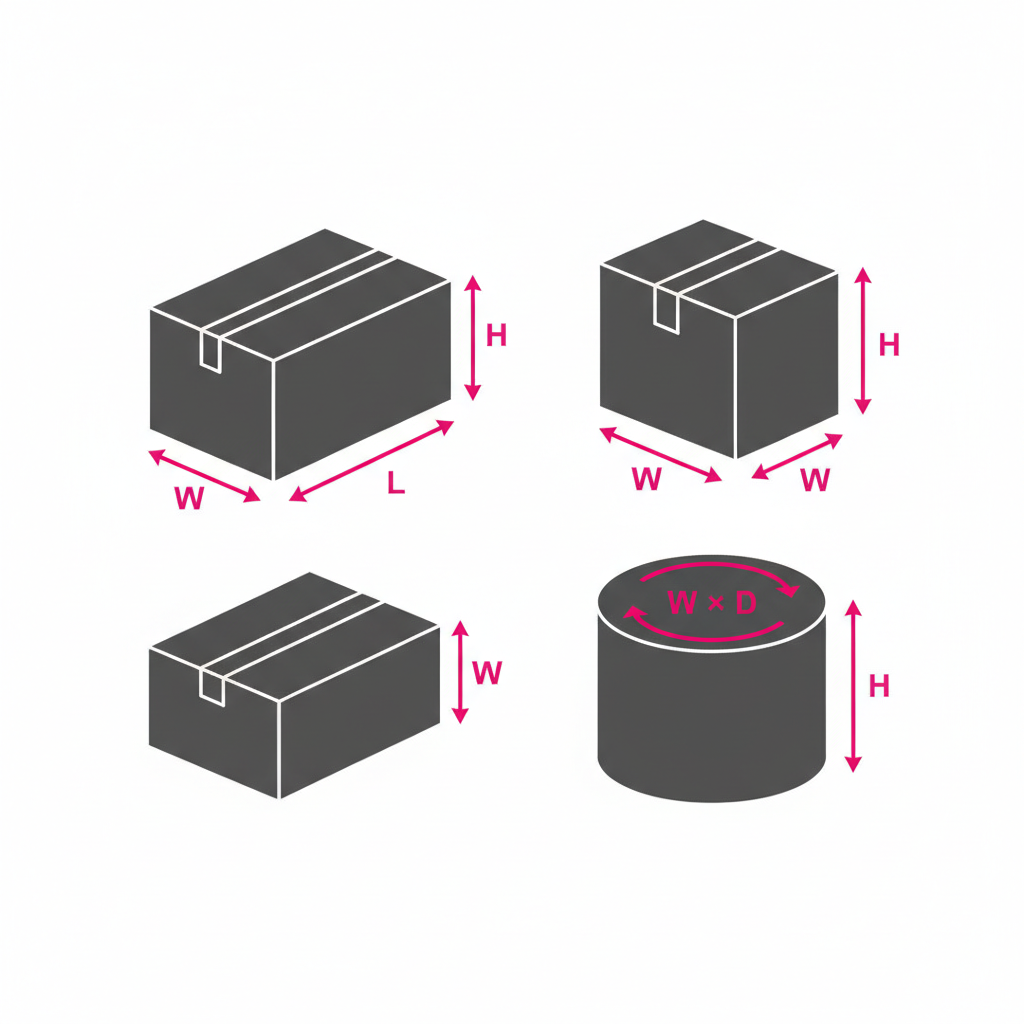
Quick answer: Package dimensions are the length, width and height of a shipment measured at its outermost points, including bulges, handles and labels. Length is the longest side. Carriers use package dimensions to calculate dimensional weight, apply oversize surcharges and check size limits, so each measurement should be rounded to the nearest whole inch.
Package dimensions — length, width, and height — are the foundation of carrier billing. Every major carrier uses dimensions to calculate dimensional weight (DIM weight), which is then compared to actual weight. You are billed for whichever is higher.
Getting dimensions wrong means overbilling customers, underbilling carriers, or generating disputes that delay payment and erode trust. Consistent, accurate dimension capture is a prerequisite for any efficient shipping operation.
Carriers define package dimensions as the outer bounding box — the smallest rectangular box that fully contains the shipment, including all packaging, handles, and protrusions.
For irregular shapes, measure the maximum extent in each dimension. Round up to the nearest whole unit (inch or centimeter, depending on the carrier).
CarrierMax LengthMax Girth + LengthMax WeightUPS108 in165 in150 lbsFedEx119 in165 in150 lbsUSPS Priority108 in130 in70 lbsDHL Express120 inVaries by service154 lbs
Packages exceeding these limits are classified as oversize and subject to additional surcharges — regardless of actual weight.
Once you have accurate dimensions, dimensional weight is calculated as:
DIM Weight = (L × W × H) ÷ DIM Factor
The DIM factor varies by carrier (139 for UPS/FedEx domestic, 166 for USPS and air freight). Your billed weight is the higher of actual weight vs DIM weight.
Example: A 24" × 18" × 10" box weighing 8 lbs:
Major carriers reserve the right to remeasure packages at any point in transit. If their measurement differs from what was declared, they issue a billing correction — often weeks after the original shipment. These corrections add up quickly for high-volume shippers.
To avoid corrections, your declared dimensions must match actual dimensions to within carrier tolerance (typically ±0.5 inches for domestic parcels).
Manual measurement with a tape measure is the root cause of most dimension-related billing problems. An automated dimensioning system eliminates all manual steps:
Operation TypeVolumeRecommended SystemCounter / induction pointUp to 500 pkgs/hrCubiQ ONE (static)Conveyor sortation line500–5,000+ pkgs/hrCubiQ LINE (in-motion)Pallet and freightAnyCubiQ X / DTPS24
Place the package on a flat surface, measure the longest side as length, then width and height at the widest points, including any bulges. Round each value to the nearest whole inch (or centimeter) and write them as L × W × H.
Length plus girth is length + 2 × width + 2 × height. Carriers use it to set maximum package sizes and oversize surcharges; for example, many US parcel services cap packages at 165 inches in length plus girth.
Carriers calculate dimensional weight from package dimensions and charge the higher of dimensional and actual weight. A box that is a few inches larger than needed can cost more to ship than its contents weigh.
Warehouses and couriers use parcel dimensioners that measure L×W×H, weight and barcode in about one second. CubiQ ONE measures packages from 2 to 31 inches per edge; CubiQ LINE measures on a moving conveyor at up to 3,600 packages per hour.
Carriers audit dimensions at their hubs and issue adjustments with extra fees when declared data is wrong. Measuring every package at origin with a dimensioner prevents these adjustments and gives you evidence to dispute incorrect ones.
Last updated: September 30, 2026. Specifications reflect current CubiQ product data.
_vector.svg)