
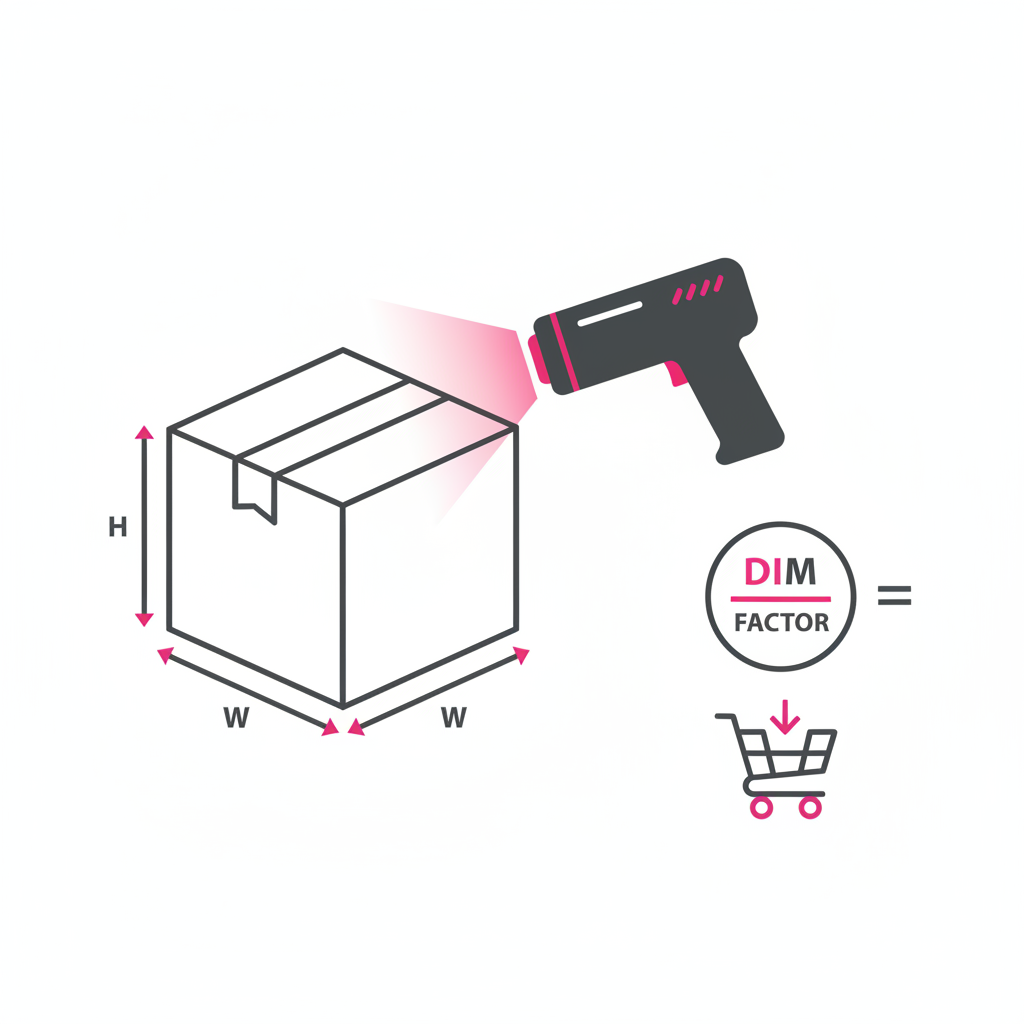
Dimensional weight (DIM weight) is a pricing method used by all major parcel carriers that converts a package's volume into a billable weight. The DIM weight formula for most US carriers is: (Length x Width x Height in inches) / 139 = DIM weight in pounds. The carrier bills the greater of actual weight or DIM weight.
For lightweight but bulky products common in e-commerce (clothing, shoes, electronics accessories, home goods), DIM weight frequently exceeds actual weight. A pair of sneakers in their retail box might weigh 2 pounds but ship in a box measuring 14 x 10 x 8 inches, producing a DIM weight of (14x10x8)/139 = 8.05 pounds. The carrier bills 8 pounds, not 2.
When e-commerce fulfillment centers use estimated or nominal dimensions for shipping labels rather than measured dimensions, they systematically understate DIM weight and incur carrier-applied weight corrections on every low-density shipment. These corrections appear as billing adjustments weeks after the shipment, at rates that are typically higher than the original shipping quote.
The financial exposure from DIM weight underdeclaration scales with shipment volume. Consider a fulfillment operation shipping 10,000 parcels per day:
This exposure is not theoretical. Major carriers including FedEx and UPS actively audit shipment dimensions and issue billing adjustments for declared dimensions that do not match their measured dimensions at sorting facilities.
Parcel dimensioning systems are deployed at three primary points in e-commerce fulfillment:
Dimensioners integrated at the packing station capture carton dimensions as each order is packed. The system reads the box size, calculates DIM weight, and applies the correct shipping class before the label is printed. This is the most effective deployment point because dimensions are captured immediately after the carton is sealed, before the DIM weight calculation has any opportunity to be wrong.
High-throughput packing lines use overhead or side-mounted dimensioners that measure cartons automatically as they exit the sealing station, without any packer interaction required. Throughput of 800-1,500 cartons per hour is achievable with this configuration.
For operations where packing and shipping are physically separated, conveyor-mounted dimensioners measure cartons as they travel on the outbound sortation line. Measurement happens at conveyor speed (typically 1.5-3 m/s) and is triggered by photocells as each carton enters the measurement zone.
Conveyor dimensioners output L, W, H, and weight (when integrated with a checkweigher) in real time, feeding the data to the WMS or shipping system for label generation or rate shopping before the carton reaches the carrier pickup point.
For smaller operations that do not have integrated packing lines, kiosk-style dimensioners at the manifesting station capture dimensions at the point where carrier labels are generated. The operator places the carton on the measurement platform, the system captures dimensions and weight, and the correct DIM weight class is applied before label printing.
Many e-commerce operations pre-load nominal item dimensions into their WMS or OMS (order management system) at the time of product setup. These dimensions are often taken from vendor specifications, which may describe the product itself rather than the packed shipping carton. When multiple products are consolidated into a single carton, nominal dimensions compound the error.
A dimensioning system at the packing station replaces nominal dimensions with verified carton dimensions at the time of pack. Over time, verified dimension data can also be used to update item master records, improving shipping cost estimates during order checkout and rate shopping accuracy in the TMS.
Major carriers operate automated dimension audit programs at their sorting facilities. When a parcel passes through a carrier's dimension portal and the measured volume differs from the declared dimensions on the label by more than an acceptable tolerance, a billing adjustment is automatically generated.
The adjustment rate for dimension discrepancies varies by carrier. Some carriers charge the full dimensional weight correction plus a re-weigh fee (typically $16-28 per package). For high-volume shippers, even a 1-2% adjustment rate on 10,000 daily parcels generates 100-200 billing adjustments per day, representing significant administrative overhead in addition to the direct charge.
A dimensioning system at the fulfillment center essentially pre-audits every shipment before the carrier does, eliminating the condition that triggers adjustments.
With verified dimensions, the shipping system can perform more accurate carrier rate shopping. DIM weight rates vary by carrier, service level, and zone. A carton with a DIM weight of 12 pounds may have significantly different rates across USPS Priority Mail, UPS Ground, FedEx Ground, and regional carriers.
Without accurate dimensions, rate shopping is performed on estimated DIM weight, which may not reflect the actual rate that will be charged. With verified dimensions, the rate shopping result is accurate, and the selected carrier and service level will actually bill at the quoted rate.
FedEx and UPS use a DIM factor of 139 for ground shipments and 139 for domestic air. USPS uses a DIM factor of 166 for Priority Mail and Priority Mail Express for packages over 1 cubic foot. Regional carriers vary. The formula is: DIM weight = (L x W x H in inches) / DIM factor.
Major carriers measure a high percentage of packages at sorting facilities using automated dimensioning systems installed in their sortation infrastructure. UPS and FedEx have publicly disclosed that they measure the majority of packages. Shipments that do not pass through a measurement point are less likely to be audited, but this is not a reliable assumption for high-volume shippers.
No, but you can manage them. Using the smallest appropriate carton for each order reduces DIM weight. Measuring every shipment and declaring accurate dimensions eliminates carrier billing adjustments. Negotiating DIM factor contracts with your carrier (possible for high-volume shippers) can reduce the DIM weight premium for specific shipment profiles.
Entry-level kiosk-style dimensioners suitable for packing stations range from $3,000-$8,000. Conveyor-integrated in-motion systems for high-throughput lines range from $15,000-$60,000 depending on speed, accuracy, and integration requirements. ROI is typically achieved within 3-12 months for operations shipping more than 500 packages per day.
_vector.svg)