
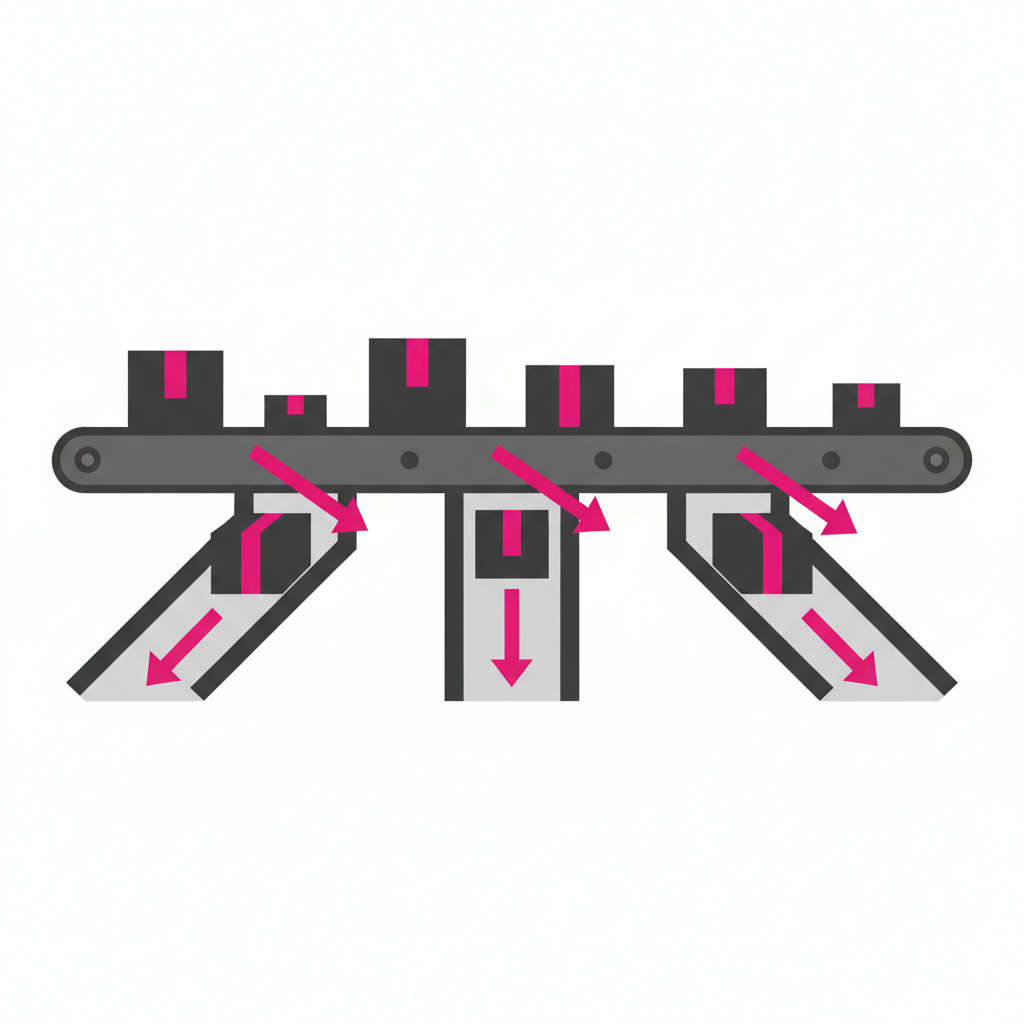
In a parcel sorting operation, the induction point — where parcels are introduced onto the sortation system — is the single highest-value location for automated measurement. Every parcel passes through induction exactly once. It is the only point where 100% measurement coverage is achievable without added handling or throughput impact.
Integrating a dimensioning and weighing system at sort induction means that by the time a parcel reaches the first divert decision, the system already knows its dimensions, weight, DIM weight, barcode, and label data. Sort decisions can then be made on size class, weight class, and DIM weight tier — enabling more precise routing and accurate billing simultaneously.
A parcel sorter (also called a sortation system) is a conveyor-based system that automatically routes parcels to the correct destination chute, lane, or container based on a read trigger. Common types:
A dimensioning and weighing system is positioned upstream of the first sort divert — typically within the first 2–3 meters of the induction belt. As each parcel passes through, the system captures dimensions, weight, and barcode in under 200 milliseconds and sends data to both the warehouse control system (WCS) and the WMS simultaneously.
The WCS uses measurement data to:
The WMS uses the same data to create the shipment record, calculate DIM weight for billing, and generate outbound documentation — all before the parcel reaches its first divert point.
CubiQ LINE mounts above an induction conveyor and captures dimensions, weight, barcode, and OCR label data in a single in-motion pass. Key sortation-specific capabilities:
| Specification | CubiQ LINE at Induction |
|---|---|
| Max belt speed | 2.5 m/s |
| Throughput | Up to 3,600 parcels/hour |
| Dimensional accuracy | ±2 mm |
| Weight accuracy | ±50 g (in-motion) |
| Barcode read rate | >99.5% |
| Barcode + OCR read rate | >99.8% |
| WCS output latency | <50 ms per scan |
Some operations use a standalone measurement station before the sorter rather than integrating at induction. The difference:
Integrating at the sorter induction point eliminates the pre-induction station entirely.
A sorter induction integration project starts with a conveyor and WCS layout review. CubiQ's engineering team assesses belt speed, parcel gap requirements, existing scanner positions, and WCS integration points. Most installations at existing sortation induction points are complete within 2–3 weeks including WCS and WMS integration. Contact CubiQ to start the layout assessment for your sort center.
_vector.svg)