
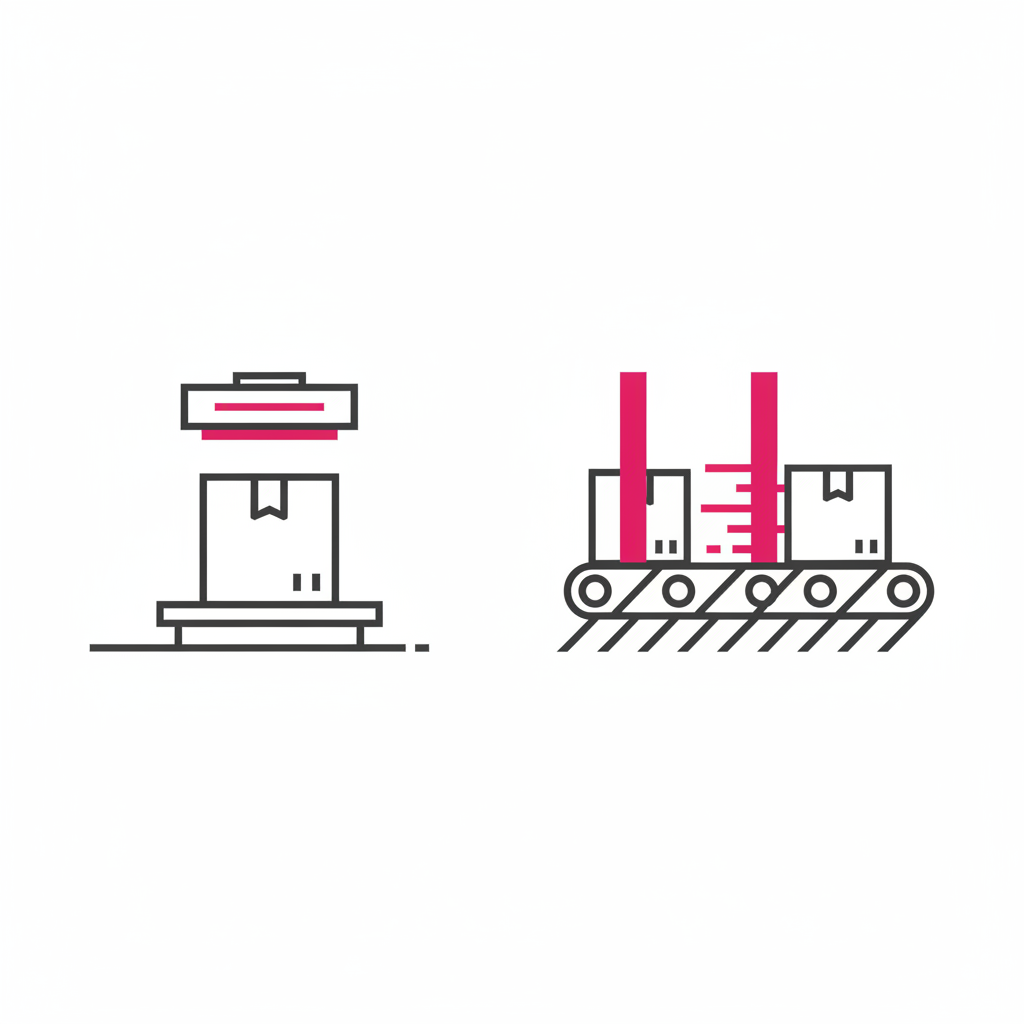
The single most important decision when deploying a dimensioning system is whether packages will be stationary or moving during measurement. This determines your system type, throughput ceiling, accuracy profile, infrastructure requirements, and total cost of ownership.
Static dimensioners capture dimensions while a package rests on a measurement platform or scale. In-motion dimensioners capture dimensions while packages travel along a conveyor without stopping, processing them continuously at belt speed.
In a static configuration, the package is presented to the sensor array while stationary. This removes the complexity of motion compensation entirely, allowing the sensor to take multiple readings for higher accuracy. The system triggers on operator action rather than continuous belt monitoring.
In-motion systems deploy sensor arrays above a moving conveyor. As packages pass through the measurement zone, encoder pulses synchronize measurements with belt speed, capturing a complete dimensional profile in real time without stopping the package.
| Factor | Static | In-Motion |
|---|---|---|
| Throughput | 100–500 pkg/hr | 3,000–10,000+ pkg/hr |
| Accuracy | ±1–2 mm | ±2–5 mm |
| Cost range | $3,000–$25,000 | $20,000–$150,000+ |
| Installation | 2–8 hours | 1–5 days |
| Operator per package | Yes | No |
| Conveyor required | No | Yes |
Many operations deploy both configurations: in-motion on the primary sortation line for automated high-volume processing, and static stations at receiving docks for inbound goods-in, oversized items that cannot travel the main conveyor, or exception handling. This hybrid approach delivers full operational coverage.
Not typically. Static and in-motion dimensioners are different product categories with different sensor configurations and software architectures. In-motion throughput requires a new system purchase, not an upgrade.
Most systems are designed for belt speeds of 0.3–1.5 m/s (60–300 ft/min). Some high-performance systems operate up to 3 m/s. Confirm the rated belt speed range before purchasing.
Yes. A minimum package gap of 20–50 cm is typically required for reliable start/end detection. Upstream spacing or divert systems may be required if packages arrive gapless.
Static achieves higher raw accuracy. However, both configurations can achieve legal-for-trade certification under OIML R-50 when properly calibrated. Verify certification status of the specific system rather than assuming by type.
_vector.svg)