
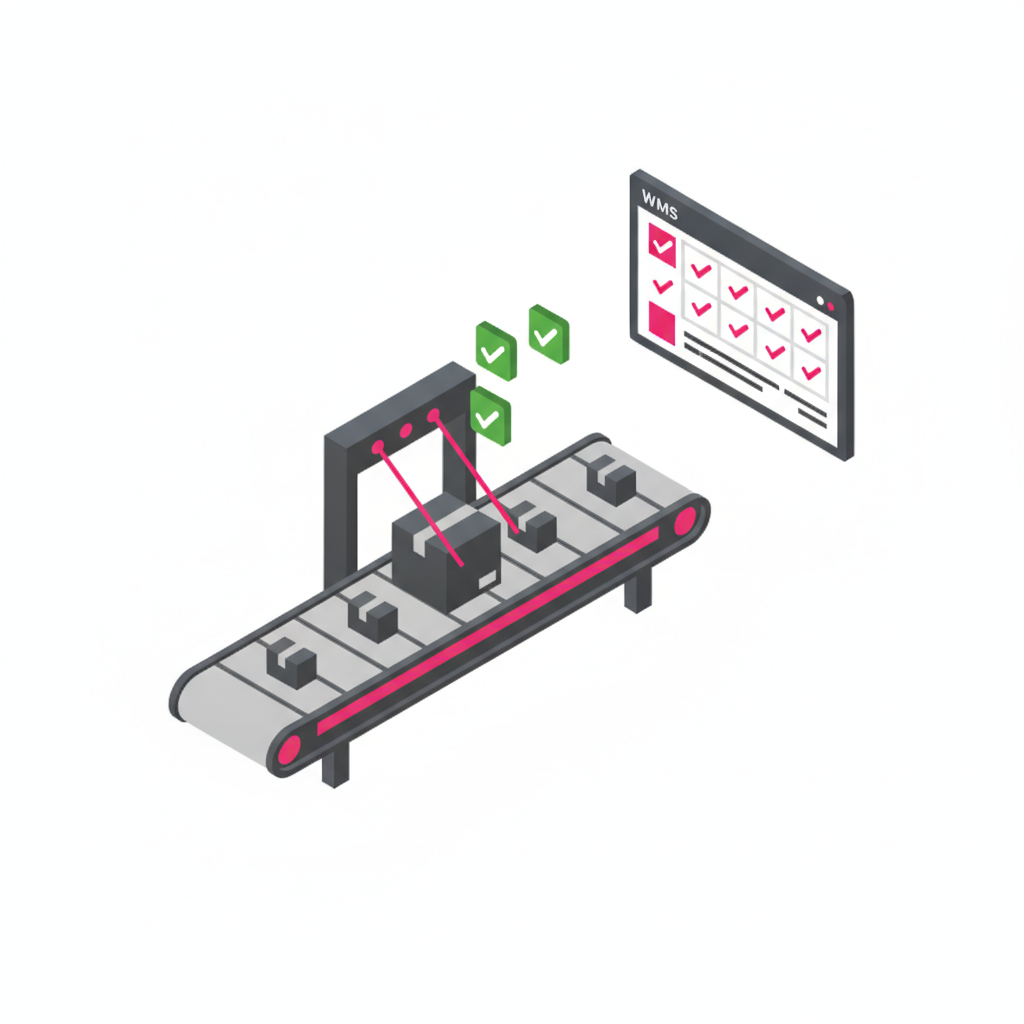
Warehouse automation is the use of technology, software, and mechanical systems to perform tasks that were previously done manually — from receiving and measuring inbound freight to picking, sorting, and shipping outbound orders. Rather than replacing every human in the building, modern warehouse automation targets the high-volume, repetitive, error-prone steps that slow down throughput and inflate operating costs.
For logistics operators — 3PLs, couriers, freight carriers, and large-scale warehouses — automation is no longer a competitive differentiator. It is a baseline requirement. Labor shortages, rising fuel surcharges, and the relentless pressure on dock-to-stock cycle times have made manual processes economically unsustainable at scale.
A WMS is the software layer that orchestrates inventory, order management, labor, and equipment. It directs where product goes, tracks every movement, and generates the data feeds that other automation systems consume.
Conveyors move parcels, totes, and pallets between zones without manual handling. Sortation systems — tilt-tray, cross-belt, or pop-up wheel — divert items to the correct shipping lane or storage location based on barcode or RFID data.
Autonomous mobile robots (AMRs) and automated storage and retrieval systems (AS/RS) bring inventory to stationary pickers, reducing the walk time that consumes 60–70% of picker labor in traditional warehouses.
Every parcel, pallet, or piece of freight must be measured and weighed. Automated dimensioning systems capture length, width, height, and weight in under one second — at the point of induction, on a conveyor line, or as pallets pass through a drive-through portal.
CubiQ Technologies builds purpose-built dimensioning systems for each stage of the logistics workflow:
Fixed tunnel scanners, handheld devices, and RFID portals create the item-level traceability that ties every physical movement to a digital transaction.
AI sits above all physical automation layers, consuming sensor data to optimize slot allocation, predict labor demand, flag anomalies in scan data, and continuously improve picking routes.
| Automation Category | Typical Cost Range | Notes |
|---|---|---|
| Warehouse Management System (WMS) | $50,000 – $500,000+ | SaaS tiers start lower; enterprise WMS can exceed $1M |
| Conveyor and sortation system | $200,000 – $2,000,000+ | Highly dependent on throughput and facility layout |
| Robotic picking / AMRs | $100,000 – $1,500,000+ | Per-robot costs $30K–$80K |
| Dimensioning systems | $8,000 – $80,000 | Static units at lower end; conveyor portals at higher end |
| Barcode / RFID infrastructure | $20,000 – $200,000 | Depends on fixed vs. handheld mix |
| AI / analytics platform | $15,000 – $150,000/year | Usually SaaS; often bundled with WMS |
Payback Period = Total Investment ÷ Annual Savings
Annual savings should account for: reduced labor hours, recovered DIM weight billing revenue, lower error rates and claim costs, improved throughput, and reduced dwell time penalties.
Example: A regional 3PL invests $45,000 in a CubiQ LINE in-motion dimensioner. The system processes 8,000 parcels per day. Prior to automation, 12% of shipments had incorrect dimensions, resulting in $18,000/month in billing disputes and uncaptured DIM weight revenue. After deployment, disputes drop 94%. Total annual savings: $210,000. Payback period: approximately 2.6 months.
Warehouse automation is the use of technology systems — including WMS software, conveyors, robotic picking, dimensioning equipment, and AI — to perform warehouse tasks with reduced human intervention.
An automated warehouse is a facility where the majority of repetitive, high-volume tasks — receiving, measuring, sorting, picking, packing, and shipping — are performed or directed by integrated technology systems.
Costs range from under $10,000 for a single dimensioning station to $5M+ for a fully automated AS/RS system. Most mid-size operations begin with $150,000–$500,000 targeting the highest-ROI process gaps.
Audit your process bottlenecks, prioritize technologies with fast payback (dimensioning, WMS, scanning), establish baseline metrics, select systems with open APIs, and pilot before scaling.
AI improves warehouse automation through predictive slotting, computer vision quality control, anomaly detection on scan data, demand-driven labor scheduling, and natural language operational interfaces.
AI integration is accelerating ROI of physical automation investments. Labor shortages are pushing adoption timelines forward, and cloud-native WMS platforms are lowering the entry barrier for mid-size operators.
_vector.svg)