
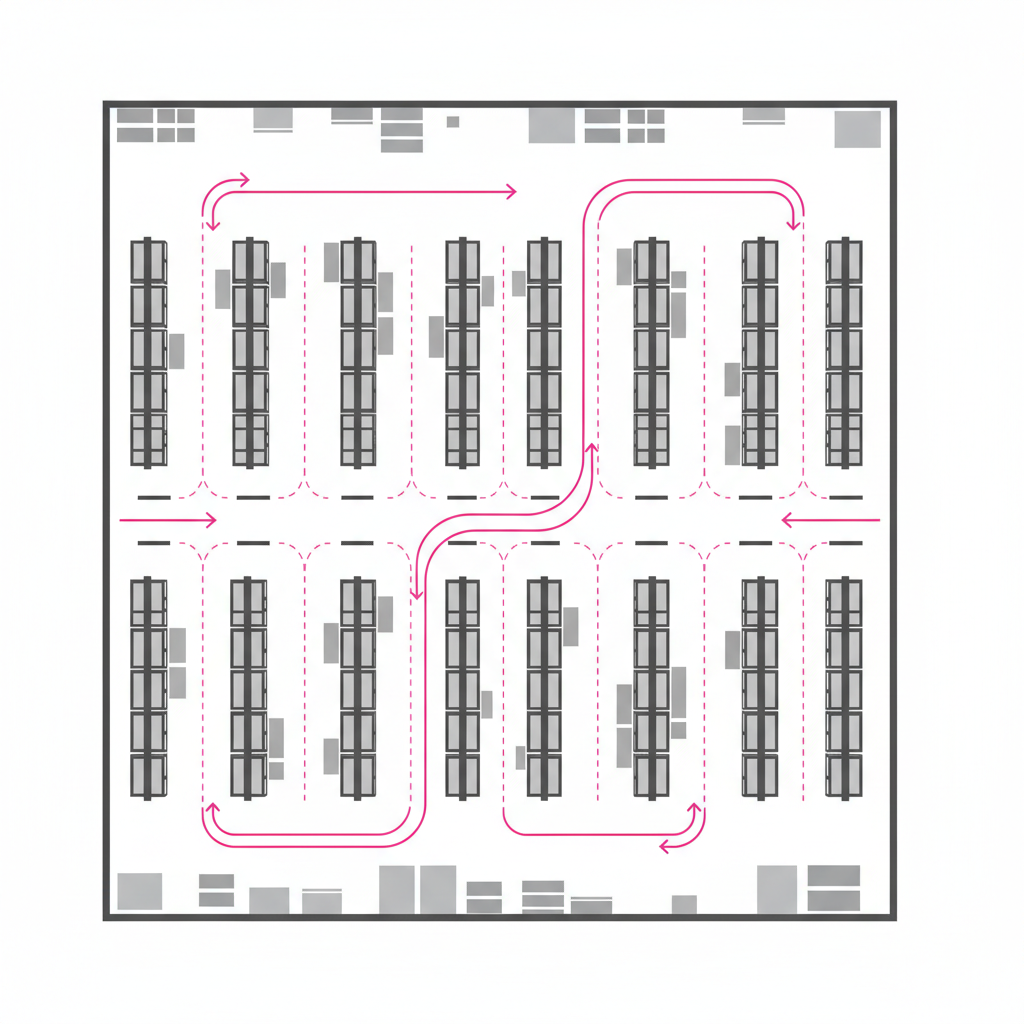
Warehouse costs represent 20–30% of total logistics spend for most distribution-intensive businesses. Labor, space, and error correction account for the bulk of those costs — and all three are addressable with the right operational strategies.
The most impactful step in warehouse optimization is capturing accurate dimensional and weight data for every SKU and shipment at inbound intake. Without this, slotting, storage assignment, vehicle loading, and billing are all based on estimates.
Deploying an automated dimensioning station at the inbound dock gives you certified data that flows into your WMS automatically — setting up every downstream process for higher accuracy.
Slotting — the assignment of SKUs to specific storage locations — has an outsized impact on pick productivity. SKUs picked frequently should be closest to the outbound dock, at ergonomic height, and in locations sized for their actual dimensions. Without accurate dimensional data, slotting decisions are made by weight or guess.
Manual measurement is the single largest source of data error in warehouse operations. Replacing tape measures with automated dimensioning at inbound, outbound, and pack stations eliminates the error source rather than trying to detect it downstream.
You cannot optimize what you cannot see. Real-time dashboards showing units per hour, dock-to-stock time, order accuracy rates, and outbound fill rates give supervisors the visibility to intervene before a bottleneck becomes a delay.
CubiQ's measurement platform includes a live operations dashboard that tracks throughput by station, shift, and product category — with alerts for anomalies like sudden drops in scan rate or measurement outliers.
Trucks that leave partially empty represent pure lost revenue. Load optimization software — fed with actual cubic dimensions of every order — maximizes vehicle utilization without exceeding weight limits. Operations relying on declared or estimated dimensions consistently under-utilize vehicle capacity by 10–20%.
Damage claims, mis-picks, and short-shipment disputes each trigger a cycle of investigation and re-shipment. Photographic and measurement evidence captured at the scan point eliminates most of these cycles: if the item was scanned out in correct condition, the record proves it.
Receiving bottlenecks — where trucks wait while dock staff manually scan and record arriving freight — are a common efficiency killer. Integrating OCR label reading at the inbound scan point captures reference numbers, shipper data, and PO numbers automatically, eliminating the manual keying step.
All of the above strategies deliver full value only when measurement data flows automatically into your WMS and ERP. API-connected dimensioning systems eliminate the data entry step between physical handling and digital record.
CubiQ's REST API integrates with SAP, Oracle WMS, CargoWise, and custom ERP environments with typical go-live times of 1–5 days. Book a warehouse optimization assessment to identify your highest-impact measurement gaps.
_vector.svg)