
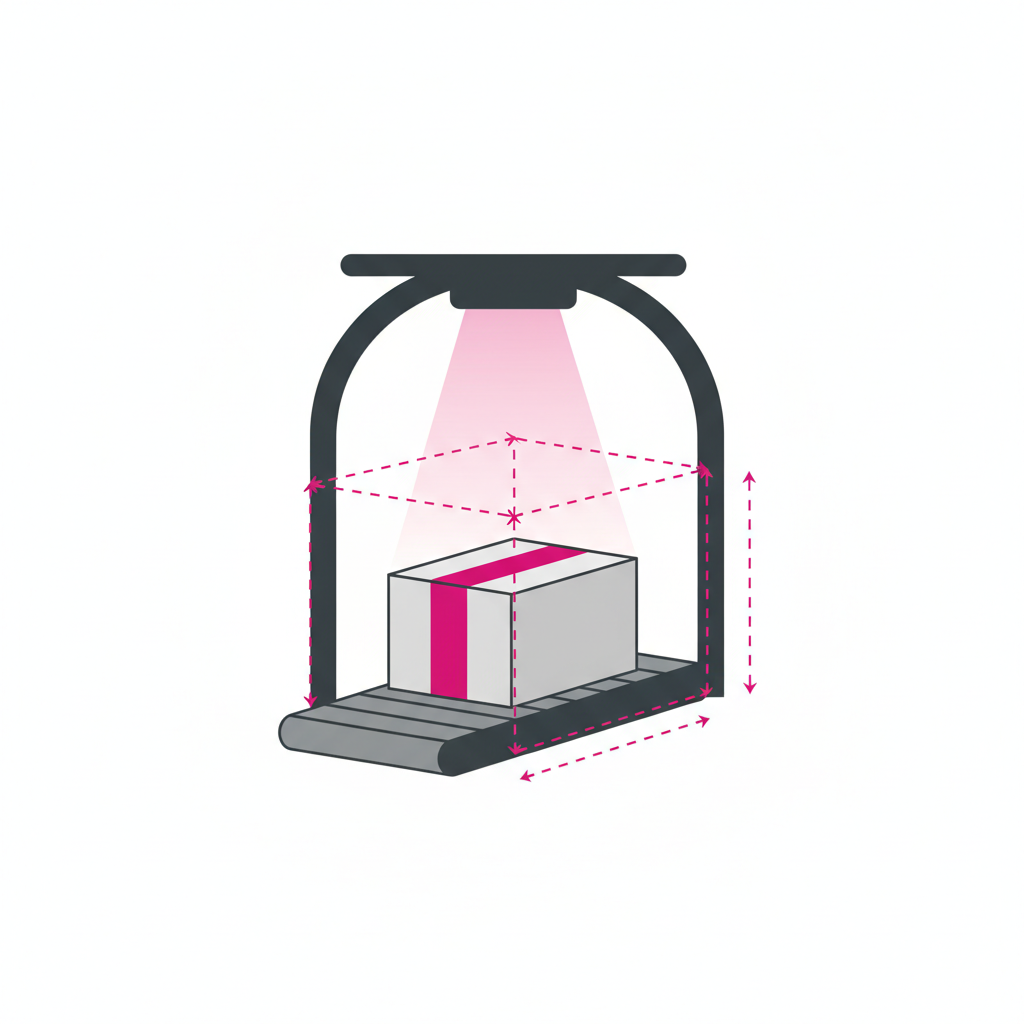
Quick answer: A parcel dimensioner (parcel dimensioning system) automatically measures the length, width, height and weight of boxes, envelopes and polybags in about one second, and reads the barcode in the same scan. Couriers, e-commerce warehouses and sort centers use parcel dimensioners to bill dimensional weight correctly and feed accurate data to WMS and carrier systems.
A parcel dimensioning system is an automated device that measures the length, width, and height of a shipment in real time — typically in under one second — and combines that data with the item's actual weight to calculate dimensional (DIM) weight. The system records and transmits this data directly to warehouse management systems (WMS), transportation management systems (TMS), or billing platforms, eliminating manual tape-measure processes entirely.
Parcel dimensioning systems are used by courier companies, fulfillment centers, postal operators, third-party logistics providers (3PLs), and retail distribution centers to automate the capture of shipment data at intake or sortation.
Modern parcel dimensioners use one or more of the following sensor technologies to reconstruct the three-dimensional shape of a package:
Most systems operate in two configurations: static (the package is placed on a measurement platform that captures dimensions when still) and in-motion (packages pass through a dimensioning gate on a moving conveyor without stopping).
A fully integrated parcel dimensioning system captures and records the following per shipment:
This data is transmitted in real time via API, flat file, or direct database integration to downstream systems.
The financial stakes of inaccurate parcel dimensions are significant. Carriers bill based on the higher of actual weight or dimensional weight. A package that is 40 cm × 30 cm × 25 cm and weighs 2 kg has a DIM weight of approximately 7.5 kg using a 5,000 DIM factor — meaning the carrier charges based on 7.5 kg, not 2 kg. If this calculation is wrong by even a few centimeters due to manual measurement error, it results in either underbilling (revenue loss for the carrier) or overbilling (dispute risk).
Studies across the courier industry consistently show that manual dimensioning introduces errors in 3–12% of shipments. At high volumes — say, 10,000 parcels per day — this translates to hundreds of incorrectly billed packages daily.
The package is placed on a scale or platform, and sensors capture its dimensions while stationary. These systems are ideal for intake desks, service counters, and low-to-medium volume applications. They typically achieve throughput rates of 100–500 packages per hour depending on operator speed.
Packages move through a dimensioning gate on a conveyor belt without stopping. These are designed for high-volume sortation environments and can process 3,000–6,000 packages per hour or more. Data capture happens in milliseconds as the package passes through the sensor array.
Portable devices use structured light or ToF sensors to measure packages in any location. These are used for on-dock spot checks, receiving audits, or in environments where a fixed installation is not practical.
A parcel dimensioning system generates value only when its data flows into the right downstream systems. Common integrations include:
Modern dimensioning platforms offer REST API, SOAP, flat file (CSV/XML), and direct database connectors. Implementation timelines typically range from 1 to 5 business days for standard integrations.
When selecting a parcel dimensioning system, logistics operations managers should evaluate the following criteria:
A parcel dimensioner is designed for individual packages, envelopes, and small-to-medium shipments — typically up to 120 cm on the longest edge. A pallet dimensioner measures fully loaded pallets, including irregularly stacked freight, and handles dimensions up to 200 cm × 120 cm × 240 cm or larger.
High-performance parcel dimensioning systems achieve measurement accuracy of ±1 mm to ±3 mm. This is significantly more accurate than manual tape measurement, which typically produces errors of ±5–20 mm depending on operator technique.
Yes. Most modern systems calculate the minimum bounding box — the smallest rectangular box that fully contains the package — regardless of the actual package shape. This is the standard method for DIM weight calculation across carriers globally.
Physical installation of a static dimensioner typically takes 2–4 hours. In-motion conveyor systems require 1–3 days including mechanical integration and calibration. Software integration with WMS/TMS systems typically takes 1–5 additional days depending on system complexity.
ROI depends on volume and error rate, but operations processing 500+ parcels per day with manual dimensioning typically recover the investment within 6–18 months through recovered DIM weight revenue, reduced billing disputes, and labor savings from eliminated manual measurement.
| System | Type | Measuring range (per edge) | Scan time | Throughput |
|---|---|---|---|---|
| CubiQ ONE | Static parcel dimensioner | 2 in – 31 in | < 1 second | Up to 360 packages/hour |
| CubiQ LINE | In-motion conveyor dimensioner | 2 in – 32 in | 1 second | Up to 3,600 packages/hour |
| CubiQ X / XL | Pallet and oversized freight dimensioner | 12 in – 79 in | 2 seconds | Up to 120 pallets/hour |
| CubiQ DTPS | Drive-through pallet scanner | 19 in – 118 in | 2 seconds | Up to 250 pallets/hour |
All CubiQ systems capture dimensions, weight, barcodes, label text (OCR) and HD photo evidence in one scan, and push records to WMS, ERP and TMS platforms via REST API and webhooks.
Last updated: September 30, 2026. Specifications reflect current CubiQ product data.
_vector.svg)